NBA Player Workout Routine and Body Care Guide

NBA Player Workout Routine and Body Care Guide
Have you ever wondered how NBA players stay in incredible shape throughout a grueling 82-game season? These athletes perform at the highest level, running up and down the court, jumping, sprinting, and defending with intensity every single night. It’s not magic – it’s dedication, planning, and a serious commitment to their bodies.
An NBA player workout routine is much more than just hitting weights or running on a treadmill. It’s a complete system that combines strength training, basketball-specific drills, proper nutrition, recovery techniques, and mental preparation. Professional basketball players understand that their body is their business, and they treat it that way.
This guide will walk you through exactly what NBA players do to stay fit, strong, and healthy. Whether you’re an aspiring athlete, a fitness enthusiast, or just curious about how the pros train, you’ll find practical information you can apply to your own fitness journey.
What Makes NBA Players So Fit?
NBA players are often considered among the most athletic and well-rounded athletes in professional sports. Let’s break down what makes them so incredibly fit.
Strength
NBA players need serious strength to compete at the professional level. They’re constantly being fouled, pushed, and challenged by defenders who weigh over 250 pounds. Building muscle isn’t just about looking good – it’s essential for performance.
Professional basketball players can bench press 300+ pounds and squat even more. This strength helps them drive to the basket, fight for position in the post, and stay balanced when defenders are draped all over them. The strength training component of an NBA fitness training program focuses on functional movements that translate directly to basketball performance.
Speed
Basketball is a game of inches and milliseconds. The difference between a steal and getting beaten is often just a step or two. NBA players develop explosive speed through plyometric training, sprint work, and ballistic movements.
Speed comes from powerful leg muscles, quick-twitch muscle fibers, and neuromuscular coordination. When you watch an NBA player accelerate from a standing position to full speed in just two or three steps, that’s the result of years of intentional speed training. This is why basketball player workout programs always include sprint work and explosive drills.
Agility
Being strong and fast doesn’t mean much if you can’t change direction quickly. Basketball demands constant acceleration, deceleration, and lateral movement. Agility is what separates good players from great ones.
NBA body care includes training to improve cutting ability, lateral quickness, and body control. Cone drills, ladder work, and change-of-direction exercises are staples in every professional basketball training program. These movements train the nervous system and muscles to work together efficiently.
Endurance
Playing at maximum effort for 48 minutes (or more with overtime) requires serious cardiovascular fitness. NBA players have some of the highest VO2 max levels of any athletes. Their hearts are incredibly efficient at delivering oxygen to muscles.
Building endurance requires consistent cardio work, interval training, and sport-specific conditioning. A basketball player workout that ignores cardiovascular fitness will fail under the demands of actual competition. This is why conditioning is woven throughout an NBA training schedule, not just saved for occasional runs.
[IMAGE PROMPT: Realistic NBA athlete performing intense training drill in professional basketball gym, sweat dripping, dynamic movement, high detail, cinematic lighting, fitness photography, 16:9 aspect ratio]
NBA Player Workout Routine
Now let’s dive into what an actual NBA player workout routine looks like. Most NBA teams follow similar principles, though individual players customize based on their position, strengths, and weaknesses.
Morning Warm-Up
Every serious basketball player workout starts the same way – with a proper warm-up. NBA players never jump straight into intense exercise. Their bodies are too valuable to risk injury through careless preparation.
A typical warm-up takes 15-20 minutes and includes dynamic stretching, light movement, and mobility work. Players might start by jogging lightly, then move through leg swings, arm circles, and torso twists. Many teams include yoga-inspired movements that improve flexibility and joint mobility.
Some NBA players use foam rolling as part of their warm-up routine. This self-massage technique helps break up muscle tightness and improve blood flow before working out. It might seem simple, but these small details separate professional athletes from casual fitness enthusiasts.
Mobility Exercises
Mobility is how well your joints can move through their full range of motion. This is especially important for basketball, where players need to twist, turn, jump, and reach in every direction during games.
NBA fitness training includes dedicated mobility work that addresses common problem areas. Hip mobility is huge for basketball players because so much of their power comes from the lower body. Movements like deep squats, lunges, and pigeon pose help maintain healthy hips.
Shoulder mobility is equally important for shooters and defenders. Players do exercises that open up the shoulders and improve rotational strength. Wrist and ankle mobility work prevents injuries in these commonly stressed areas.
The best part about mobility exercises? You can do them almost anywhere, and they don’t require expensive equipment. Many of these movements are things you can incorporate into your own workout routine.
Strength Training
This is where NBA players build the power and muscle that allows them to dominate physically. Strength training in a basketball player workout program focuses on functional, compound movements – not just random isolation exercises.
Common strength exercises in an NBA training schedule include:
Bench Press: Develops chest, shoulders, and triceps. Players typically do variations like dumbbell bench press and incline bench press.
Squats: The king of lower body exercises. NBA players do various squat patterns because leg strength is fundamental to basketball performance.
Deadlifts: One of the best full-body strength builders. Some strength coaches prefer variations like trap bar deadlifts that feel more natural.
Pull-ups and Rows: Upper back and lat strength is essential for pulling the ball down on rebounds and defensive positioning.
Single-leg exercises: Lunges, step-ups, and single-leg squats are important because basketball is often played on one leg at a time.
Most NBA training sessions include 4-6 main strength movements, done for 3-4 sets of 6-10 reps. The intensity is high – these aren’t light workouts. NBA strength coaches program these sessions so players build muscle and power without getting injured.
Recovery between sets is important. Players might rest 2-3 minutes between heavy lifts, allowing their nervous system to recover for the next set.
Cardio and Conditioning
You might think NBA players just play basketball to stay in shape, but most teams dedicate specific time to conditioning work. This ensures players have the cardiovascular fitness to maintain intensity in the fourth quarter.
Common conditioning methods include:
Interval Training: Short bursts of maximum effort followed by recovery periods. For example, 30 seconds of sprinting followed by 30 seconds of walking, repeated multiple times.
Tempo Runs: Sustained running at a challenging but manageable pace for 20-30 minutes.
Court Sprints: Basketball-specific conditioning using the court itself. Players sprint baseline to baseline, corner to corner, or other patterns.
Bike and Treadmill Work: Lower-impact options that improve cardiovascular fitness without the joint stress of court work.
Most NBA fitness training includes conditioning 3-4 times per week. These sessions are hard – the goal is to create the same demands the body faces during actual games. Players learn to perform when tired, which directly translates to better fourth-quarter performance.
Basketball Skill Practice
An NBA player workout routine always includes actual basketball work. This might be shooting practice, defensive drills, pick-and-roll work, or game simulations.
This part of the NBA training schedule is crucial because it keeps training specific to the actual demands of basketball. Strength and cardio matter only if they improve basketball performance. Skill work ensures everything transfers to game situations.
Many NBA teams have their players do skill work before or after other training components. Some do it separately because basketball skill practice requires mental focus and technical precision – something that’s harder if you’re already fatigued from heavy lifting.
Evening Stretching Routine
After all the hard training, NBA players cool down with stretching and mobility work. This isn’t just for flexibility – it’s part of the recovery process.
Evening stretching might include:
- Static stretching of major muscle groups
- Light foam rolling to reduce muscle soreness
- Yoga-inspired poses that improve flexibility
- Breathing exercises that promote relaxation
This cool-down period typically lasts 15-20 minutes. It prepares the body for recovery and helps transition from intense work mode to rest mode. Many NBA players find that this routine helps them sleep better because their nervous system is properly recovered.
Weekly NBA Training Schedule
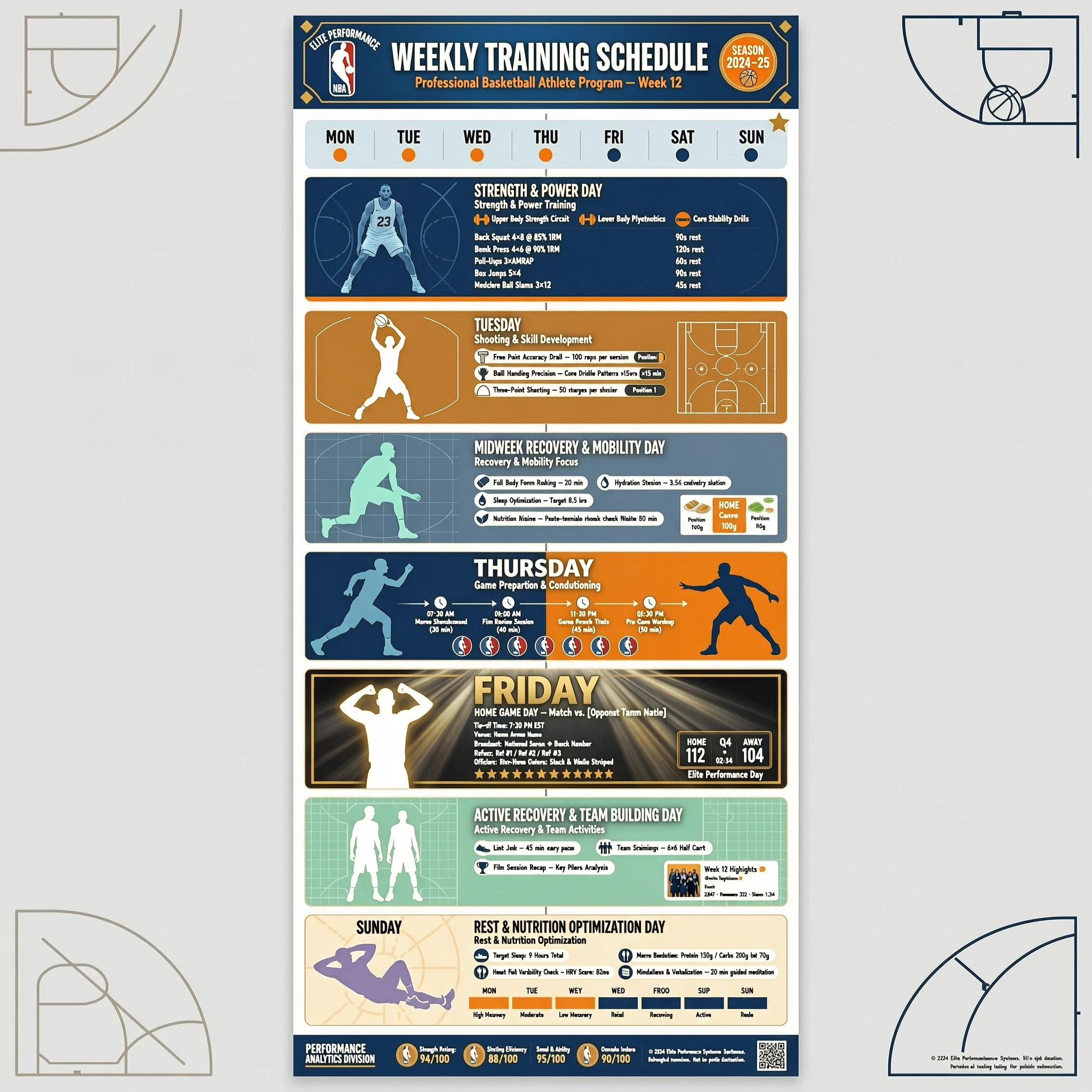
Here’s what a typical week looks like for an NBA player during the season:
| Day | Morning Session | Afternoon Session | Evening |
|---|---|---|---|
| Monday | Light recovery work, mobility | Skill drills, half-court offense | Stretching, massage |
| Tuesday | Strength training, bench press focus | Conditioning, court sprints | Ice bath, foam rolling |
| Wednesday | Mobility work, dynamic stretching | Game simulation scrimmage | Recovery focus |
| Thursday | Upper body strength, pull-ups | Shooting practice, defensive drills | Light stretching |
| Friday | Lower body strength, squats | Basketball skill work, pick-and-roll | Preparation for game |
| Saturday | GAME DAY – Pre-game preparation | Game | Ice bath, light recovery |
| Sunday | Complete rest or very light activity | Optional recovery work | Sleep and nutrition focus |
Notice that training varies throughout the week. This periodization prevents overuse injuries and keeps the body fresh for games. Different muscle groups are emphasized on different days, and intensity fluctuates based on when games are scheduled.
NBA Body Care Guide
Workout routine is only half the battle. The other half – and arguably just as important – is body care. NBA players take their recovery seriously because games are won and lost based on who has fresher, healthier bodies.
Sleep and Recovery
Sleep is where the magic happens. During sleep, your body releases growth hormone, repairs muscle tissue, and consolidates memories of new skills you’ve learned. NBA players prioritize sleep like it’s part of their training.
Most professional basketball players aim for 8-10 hours of sleep per night. Some take strategic naps during the day to accumulate more total recovery time. Sleep quality matters too – athletes maintain dark, cool rooms and avoid screens before bed to ensure deep sleep.
If you want to improve your fitness results, don’t overlook sleep. It’s free, it’s effective, and it’s something almost everyone can do better. Sleep is where your body actually builds the muscle from your workouts.
Hydration
Basketball is a sweaty sport. Players lose fluid constantly during games and training, which impacts performance and recovery. NBA teams have strict hydration protocols.
Players drink water before, during, and after every workout and game. But it’s not just water – electrolytes (sodium, potassium, magnesium) are equally important. These minerals help your body retain fluid and maintain proper muscle function.
Proper hydration improves:
- Strength and power output
- Cognitive function and decision-making
- Temperature regulation during intense exercise
- Nutrient delivery to muscles
- Recovery speed between sessions
A simple rule: if you’re thirsty, you’re already dehydrated. NBA players stay ahead of thirst by drinking consistently throughout the day.
Healthy Nutrition
You cannot out-train a bad diet. NBA players eat strategically to support their training and recovery. Most professional basketball players work with team nutritionists who plan their meals.
The basic framework includes:
Protein: Essential for muscle repair and growth. Players aim for 0.8-1 gram per pound of body weight daily. Sources include chicken, fish, lean beef, eggs, and plant-based options.
Carbohydrates: Fuel for intense exercise and brain function. Complex carbs like rice, sweet potatoes, and oats provide sustained energy.
Healthy Fats: Important for hormone production and nutrient absorption. Avocados, nuts, and olive oil are staples.
Vegetables and Fruits: Provide vitamins, minerals, and antioxidants that support recovery and immune function.
Timing matters too. Players eat carbs and protein before workouts to fuel performance, and after workouts to start recovery. Throughout the day, they eat balanced meals that support their bodies’ demands.
Ice Baths
If you’ve watched NBA games, you’ve probably seen players sitting in ice baths after games. This isn’t just tradition – it’s a legitimate recovery tool.
Ice baths reduce inflammation and muscle soreness by constricting blood vessels and reducing metabolic activity. After the body warms back up, blood rushes to the muscles, delivering fresh oxygen and nutrients. Most NBA players use ice baths for 10-15 minutes after intense games or training sessions.
The science is somewhat debated – some research suggests ice baths might slightly reduce muscle growth signals if used immediately after strength training. So timing matters. Many NBA teams use ice baths after games (which don’t require muscle growth) but not after strength sessions.
Massage Therapy
Professional massage isn’t a luxury for NBA players – it’s part of their training program. Team massage therapists work on players daily to:
- Reduce muscle tension and tightness
- Improve circulation and nutrient delivery
- Help break up scar tissue and adhesions
- Promote relaxation and nervous system recovery
Massage therapy can be combined with other recovery techniques. Many NBA players get massages while sitting in ice baths or while foam rolling. It’s all part of the comprehensive approach to athlete recovery routine.
Foam Rolling
Foam rolling is a self-massage technique that costs almost nothing but delivers real benefits. It involves using a foam roller to apply pressure to tight muscles, which improves mobility and reduces soreness.
NBA players foam roll almost daily. Common areas include:
- Quadriceps and hamstrings
- Calves
- Glutes and hips
- Upper back
- Lats
The technique is simple but intense – you roll slowly over the muscle, pausing on tender spots. It hurts a bit (in a good way), but the relief afterward is worth it.
Injury Prevention
The best injury treatment is prevention. NBA players and their medical teams work proactively to identify and address potential problems before they become serious injuries.
This includes:
Movement screening: Identifying movement patterns that could lead to injury.
Strength imbalances: Addressing weaknesses that compensate and cause problems elsewhere.
Flexibility work: Maintaining range of motion in critical areas.
Proper progression: Gradually increasing training volume and intensity to avoid overuse injuries.
Adequate recovery: Giving the body enough time to adapt to training stress.
Most NBA players wear preventative braces or supports for ankles, knees, or shoulders – addressing potential weak points before they become injuries.
Best Recovery Habits Used by NBA Players
Here are the key recovery habits that separate professional athletes from casual fitness enthusiasts:
- Consistency with stretching: Daily mobility work prevents muscle tightness
- Strategic ice baths: Used selectively after games and intense sessions
- Daily foam rolling: Addresses muscle tension before it becomes a problem
- Professional massage: Weekly or more often for optimal recovery
- Sleep prioritization: Treating sleep like a competitive advantage
- Proper nutrition timing: Eating at strategic times for maximum benefit
- Active recovery days: Light movement on non-game days accelerates recovery
- Compression garments: Some players wear compression clothing to reduce soreness
- Contrast therapy: Alternating hot and cold water baths for circulation
- Mental recovery: Meditation and stress management as part of overall recovery
- Regular monitoring: Working with medical staff to assess recovery needs
- Supplementation: Strategic use of supplements to support recovery (under medical supervision)
Sample Daily Routine of an NBA Player
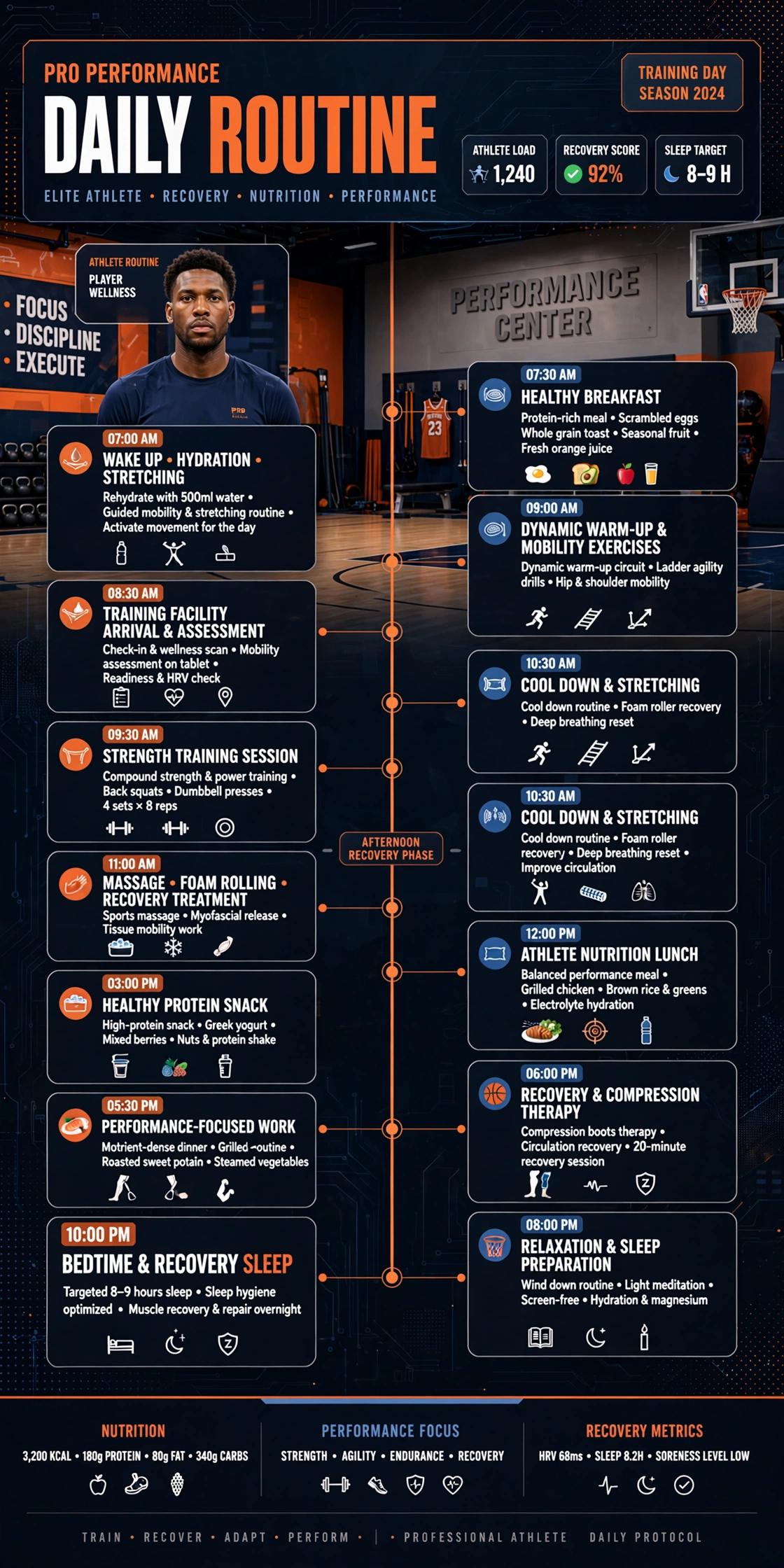
Here’s what a realistic day might look like for an NBA player during the season:
| Time | Activity |
|---|---|
| 7:00 AM | Wake up, hydrate, light stretching |
| 7:30 AM | Breakfast (eggs, toast, fruit, juice) |
| 8:30 AM | Arrive at facility, mobility assessment |
| 9:00 AM | Warm-up and dynamic stretching (20 min) |
| 9:30 AM | Strength training session (60 min) |
| 10:30 AM | Cool down and static stretching (15 min) |
| 11:00 AM | Shower and ice bath if needed |
| 12:00 PM | Lunch (grilled chicken, rice, vegetables) |
| 1:00 PM | Recovery work, foam rolling, massage (45 min) |
| 2:00 PM | Light recovery activities or day off/treatment |
| 3:00 PM | Snack (protein bar, fruit, nuts) |
| 4:00 PM | Basketball skill drills or team practice (90 min) |
| 5:30 PM | Cool down stretching and mobility work |
| 6:00 PM | Shower, compression garment recovery |
| 6:30 PM | Dinner (salmon, sweet potato, broccoli) |
| 8:00 PM | Light activity, preparation for sleep |
| 10:00 PM | Bed time (8-10 hours of sleep) |
Notice how recovery is woven throughout the day, not just saved for evening. This continuous approach keeps the body in optimal condition for repeated intense training.
Common Mistakes to Avoid
If you’re trying to develop your own NBA-inspired training program, avoid these common mistakes that limit progress:
1. Skipping the Warm-Up
Many people want to save time by jumping straight into workouts. This increases injury risk and actually decreases performance. Spend 15-20 minutes preparing your body for work.
2. Ignoring Mobility and Flexibility
You can be strong and fast but still get injured if you’re tight and immobile. Dedicate time to mobility work every single day. This is not optional for serious athletes.
3. Overdoing Cardio
Too much low-intensity cardio can actually hurt muscle growth and power development. Balance it with strength training and interval work.
4. Inconsistent Training
NBA players train year-round, though with varying intensity. Consistency matters more than intensity. Train regularly at a sustainable level rather than hard for a few weeks then taking a long break.
5. Poor Sleep and Recovery Habits
You can’t out-train poor recovery. If you’re only sleeping 5-6 hours, your training isn’t going to deliver results.
6. Improper Nutrition Timing
Just eating healthy food isn’t enough. When you eat matters for performance and recovery. Fuel before workouts and recover after them.
7. Ignoring Pain and Pushing Through Injury
NBA players are tough, but they’re not stupid. Real pain is your body’s warning system. Distinguish between normal workout discomfort and actual injury pain.
Beginner-Friendly NBA-Inspired Workout Plan
You don’t need to be a professional to benefit from NBA training principles. Here’s a simplified version anyone can follow:
Monday: Upper Body Strength
- Warm-up: 10 minutes light cardio and stretching
- Bench press: 3 sets x 8 reps
- Rows: 3 sets x 8 reps
- Pull-ups or assisted pull-ups: 3 sets x 6-10 reps
- Shoulder press: 3 sets x 10 reps
- Cool down: stretching, 5 minutes
Tuesday: Conditioning
- Warm-up: 5 minutes light jogging
- Court sprints: 30 seconds sprint, 30 seconds walk x 10
- Agility ladder drills: 5 minutes
- Cool down: walking and stretching, 10 minutes
Wednesday: Lower Body Strength
- Warm-up: 10 minutes light movement
- Squats: 4 sets x 8 reps
- Lunges: 3 sets x 10 each leg
- Deadlifts: 3 sets x 6 reps
- Calf raises: 3 sets x 15 reps
- Cool down: stretching, 10 minutes
Thursday: Skill and Light Cardio
- Shooting practice: 20 minutes
- Agility drills: 15 minutes
- Light jogging or cycling: 20 minutes
- Stretching and mobility: 15 minutes
Friday: Full Body and Recovery
- Warm-up: 10 minutes
- Light weights, moderate intensity: 45 minutes
- Stretching and foam rolling: 20 minutes
Saturday: Active Recovery
- Light walk or swim: 20-30 minutes
- Stretching and mobility: 20 minutes
- Foam rolling: 10 minutes
Sunday: Complete Rest
- Light walking if desired
- Focus on nutrition and hydration
- Extra sleep
This plan can be adapted based on your fitness level and available equipment. The key is consistency and progression – gradually increase weights and intensity over weeks and months.
Frequently Asked Questions (FAQ)
1. How many hours a day do NBA players train?
NBA players typically train 4-6 hours per day during the season, including practice, individual workouts, and recovery. In the offseason, training can be even more intensive with two-a-day sessions. Luka Doncic, for example, does two 90-minute workouts per day during the offseason.
2. What is a typical NBA player workout routine?
A typical NBA player workout routine includes a warm-up, mobility work, strength training, cardio conditioning, basketball skill practice, and a cool-down with stretching. The routine varies based on whether it’s a game day, practice day, or offseason training.
3. How do NBA players recover so fast?
NBA players use multiple recovery techniques including sleep (8-10 hours), ice baths, massage therapy, compression boots, proper nutrition, hydration, and sometimes advanced technologies like cryotherapy and hyperbaric oxygen chambers.
4. What do NBA players eat in a day?
NBA players typically eat lean proteins (chicken, fish, eggs), complex carbohydrates, healthy fats, and lots of fruits and vegetables. Many work with personal nutritionists. Luka Doncic, for example, consumes at least 250 grams of protein daily and follows a gluten-free, low-sugar diet.
5. How much do NBA players sleep?
Most NBA players aim for 8-10 hours of sleep per night. Many also take naps on game days. LeBron James blocks out two hours for a nap on home game days.
6. Do NBA players lift weights every day?
No. Most NBA players lift weights 3-4 days per week. They use other days for skill work, mobility, and recovery. Overtraining can lead to injury and burnout.
7. What is the best workout for basketball players?
The best workout for basketball players combines strength training (especially lower body and core), conditioning (sprints and interval training), and basketball-specific skill work. A well-rounded approach is better than focusing on just one area.
8. How can I start training like an NBA player?
Start with the basics: warm up properly, build a foundation of strength with bodyweight exercises, work on your conditioning with running and sprints, practice your basketball skills, and prioritize recovery with good sleep and nutrition. Don’t try to do too much too fast – consistency is more important than intensity.
Conclusion
An NBA player workout routine is far more comprehensive than most people realize. It’s not just about lifting heavy weights or running sprints – it’s a complete system that addresses strength, power, speed, agility, endurance, and recovery.
The key takeaways are:
Training is sport-specific. Basketball demands require basketball-focused training that develops applicable skills and fitness.
Recovery is part of training. Sleep, nutrition, stretching, massage, and active recovery are as important as the workouts themselves.
Consistency beats intensity. Training regularly at a sustainable level outperforms sporadic intense efforts.
Your body is a system. Everything connects – strength supports power, cardiovascular fitness enables skill execution, recovery enables adaptation.
Progression is gradual. NBA players built their fitness over years. Sustainable improvements require patience and consistent effort.
You don’t need to be a professional basketball player to benefit from these principles. Whether you’re a high school athlete, weekend warrior, or just someone wanting to get in better shape, you can apply NBA training and recovery principles to your own routine.
Start simple. Focus on consistency. Prioritize recovery. Eat well. Sleep enough. Most importantly, stay committed to the process. That’s the real secret behind NBA player success – not some special technique or supplement, but consistent effort over time.
What aspect of NBA training are you most interested in trying? Start with one small change this week and build from there. Small improvements compound into major transformations over months and years.



3 comments