Top 10 Highest Goal Scorers in FIFA World Cup History
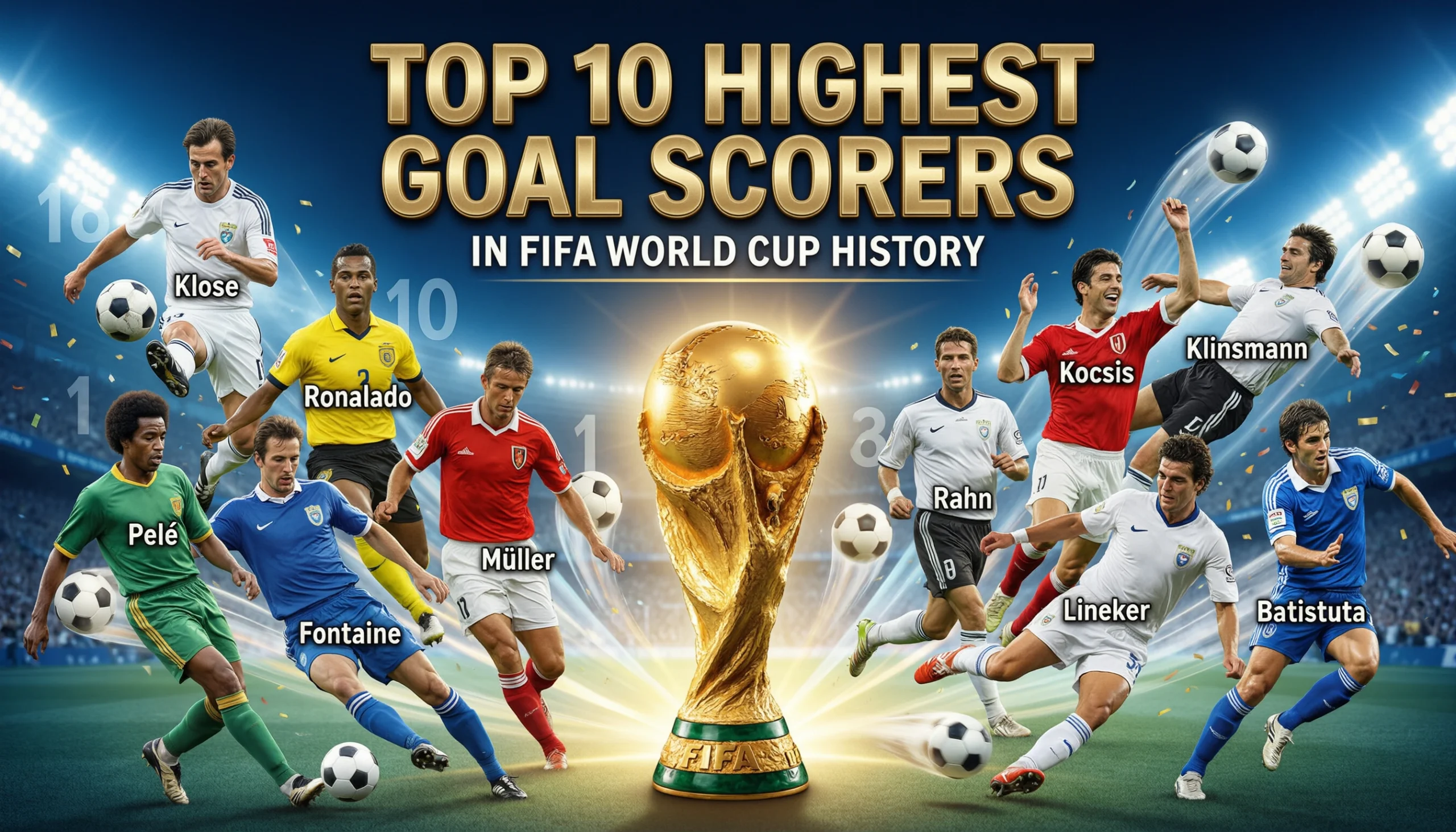
Top 10 Highest Goal Scorers in FIFA World Cup History
The FIFA World Cup represents football’s ultimate proving ground. Every four years, the world’s greatest players compete for the most coveted trophy in sports, but only a select few etch their names into history as prolific goal scorers on this grand stage.
Scoring goals at the World Cup requires more than just talent. It demands composure under immense pressure, peak physical condition, and often a touch of destiny. While countless strikers have graced World Cup tournaments since 1930, only an elite group has consistently found the back of the net across multiple editions.
The highest goal scorers in World Cup history come from different eras, playing styles, and footballing cultures. Some were pure predators in the penalty box. Others combined creativity with clinical finishing. A few dominated single tournaments with explosive performances, while others accumulated goals steadily across multiple World Cups.
This comprehensive guide examines the top 10 highest goal scorers in FIFA World Cup history, exploring their achievements, memorable moments, and what made them exceptional. These legends didn’t just score goals—they created moments that transcended sport, inspiring generations and proving that greatness reveals itself when the stakes are highest.
Quick Overview: Top 10 at a Glance
| Rank | Player | Country | Goals | Tournaments | Matches |
|---|---|---|---|---|---|
| 1 | Miroslav Klose | Germany | 16 | 4 (2002–2014) | 24 |
| 2 | Ronaldo Nazário | Brazil | 15 | 4 (1994–2006) | 19 |
| 3 | Gerd Müller | West Germany | 14 | 2 (1970–1974) | 13 |
| 4 | Just Fontaine | France | 13 | 1 (1958) | 6 |
| 5 | Lionel Messi | Argentina | 13 | 5 (2006–2022) | 26 |
| 6 | Pelé | Brazil | 12 | 4 (1958–1970) | 14 |
| 7 | Kylian Mbappé | France | 12 | 2 (2018–2022) | 14 |
| 8 | Sándor Kocsis | Hungary | 11 | 1 (1954) | 5 |
| 9 | Jürgen Klinsmann | Germany | 11 | 4 (1990–1998) | 17 |
| 10 | Multiple Players* | Various | 10 | Various | Various |
*The 10-goal mark is shared by Grzegorz Lato, Gary Lineker, Gabriel Batistuta, Teofilo Cubillas, Thomas Müller, and Helmut Rahn.
1 — Miroslav Klose | Germany | 16 Goals
The Man Who Rewrote History
If you want to understand what consistency at the highest level looks like, look no further than Miroslav Klose. Born in Poland and raised in Germany, Klose is the undisputed holder of the most World Cup goals in history — 16 goals across four World Cups, spanning over a decade of relentless dedication.
What makes his record even more remarkable is how methodically he built it. He didn’t explode onto the scene and then fade. He just kept showing up, kept finding the net, tournament after tournament.
Career Highlights & World Cup Journey
- 2002 (Japan/South Korea): 5 goals — all headers. He opened with a hat-trick against Saudi Arabia and announced himself to the world.
- 2006 (Germany): 5 goals — won the Golden Boot on home soil. Germany finished third.
- 2010 (South Africa): 4 goals — including decisive efforts in knockout wins over England and Argentina.
- 2014 (Brazil): 2 goals — including the iconic 16th goal in the 7–1 semi-final demolition of Brazil, which broke Ronaldo Nazário’s record right there on Brazilian soil.
Memorable Moment
The night of July 8, 2014 at the Mineirão in Belo Horizonte. Klose’s equaliser in the 23rd minute was actually his record-breaking 16th World Cup goal. The stadium was in stunned silence. The world watched as Klose — ever the gentleman — celebrated quietly. He later said he wanted to respect the Brazilian crowd in their moment of grief. That humility is part of what makes his legacy so enduring.
He needed 24 matches across 13 years to reach 16 goals. That’s the kind of career-long consistency that belongs in a different conversation than any single-tournament wizard.
2 — Ronaldo Nazário | Brazil | 15 Goals
If Klose was consistency personified, Ronaldo Nazário was pure, terrifying brilliance. The Brazilian striker — often called “O Fenômeno” — combined explosive pace, astonishing skill and clinical finishing in a way that no striker before or since has quite replicated.
He scored 15 goals in just 19 matches across four World Cups, which gives him one of the best goals-per-game ratios among the top scorers in this list.
Career Highlights & World Cup Journey
- 1994 (USA): Part of the squad — didn’t play in the final but won the title at just 17.
- 1998 (France): 4 goals. Brazil reached the final but lost controversially to France. The mystery surrounding his fitness before that final still sparks debate today.
- 2002 (Japan/South Korea): 8 goals — his greatest tournament. He won the Golden Boot, led Brazil to their fifth World Cup title, and scored both goals in the final against Germany. His performances that year remain among the finest individual World Cup campaigns in football history.
- 2006 (Germany): 3 goals — his last tournament. He was no longer the same physically, but still surpassed Gerd Müller’s record with his 15th goal.
Memorable Moment
The 2002 final against Germany. Ronaldo opened the scoring in the 67th minute, then added a second twelve minutes later. In that tournament, he was practically unplayable — and the smile he wore lifting that trophy was one of the great sporting images of the 21st century.
3 — Gerd Müller | West Germany | 14 Goals
Der Bomber
Gerd Müller’s nickname said it all. “Der Bomber” was a natural-born goalscorer — stocky, quick over short distances, and instinctively brilliant in the penalty area. He didn’t need much space. He didn’t need much time. He just needed the ball and a half-chance.
In just two World Cups and only 13 matches, he scored 14 goals — a rate that no player in the top ten comes close to matching. His goals-per-game average of 1.08 is genuinely staggering, especially given the quality of opposition he faced.
Career Highlights & World Cup Journey
- 1970 (Mexico): 10 goals in 6 games. West Germany finished third, but Müller was absolutely unstoppable. He won the Golden Boot convincingly. That same year, he also won the Ballon d’Or.
- 1974 (West Germany): 4 goals, including the winning goal in the final against the Netherlands. He scored the goal that made West Germany world champions on home soil.
Memorable Moment
The 1974 World Cup final. With the Netherlands dominating large stretches and the score at 1–1, Müller received a cross, swiveled away from his marker with a movement that defied logic at his size, and drilled the ball into the net. It was the goal that won West Germany the World Cup. Classic Müller — no wasted movement, pure instinct.
#4 — Just Fontaine | France | 13 Goals
The Man No One Can Match in One Tournament
Here is a FIFA World Cup record that may never, ever be broken. Just Fontaine scored 13 goals in a single tournament — the 1958 World Cup in Sweden. That is his only World Cup appearance, and yet he sits among the highest goal scorers in World Cup history based entirely on that one magnificent summer.
For context, no player in the modern era has even come close to matching his single-tournament tally. Ronaldo scored 8 in 2002. Mbappé scored 8 in 2022. Fontaine scored 13 in six games. The maths is extraordinary.
Career Highlights & World Cup Journey
- 1958 (Sweden): 6 matches, 13 goals. He scored in every single game, including a four-goal haul against defending champions West Germany. France finished third, losing the semi-final to a certain teenage sensation named Pelé.
Memorable Moment
His four goals against West Germany in the third-place play-off match — the final game of the tournament — took his tally to 13. It was almost as if he was saving the best for last. Tragically, a double leg fracture cut short his career soon after, robbing the world of what could have been a record that stood even higher.
#5 — Lionel Messi | Argentina | 13 Goals
The Greatest World Cup Story Ever Told
Ask any football fan to describe Lionel Messi’s World Cup journey and you’ll likely get a long pause followed by something emotional. For years, the greatest player of his generation seemed cursed at the World Cup. Then, in Qatar in 2022 at the age of 35, everything changed.
Messi has now scored 13 World Cup goals across five tournaments, including seven in 2022 alone — more than he’d managed in his previous four World Cups combined. He is currently within touching distance of Miroslav Klose’s all-time record, entering the 2026 World Cup in the United States needing just four goals to break it.
Career Highlights & World Cup Journey
- 2006 (Germany): 1 goal. A teenage Messi showed glimpses of his potential.
- 2010 (South Africa): 0 goals. His most painful tournament — Argentina were eliminated and Messi was strangely quiet throughout.
- 2014 (Brazil): 4 goals. He won the Golden Ball as Argentina reached the final, only to lose to Germany — ironically the team of the man whose record he now chases.
- 2018 (Russia): 1 goal. A disappointing early exit in the round of 16.
- 2022 (Qatar): 7 goals. The complete World Cup performance — leadership, assists, goals, and ultimately glory. He scored twice in the final against France, including an equaliser in the second half, and converted his penalty in the shootout. He won the Golden Ball for the second time, becoming the first player to do so.
Memorable Moment
The 2022 World Cup final is one of the most dramatic sporting events in living memory. Messi scoring from the penalty spot to equalise at 2–2 in normal time, then again to make it 3–2 in extra time, before Argentina triumphed on penalties. It was the storybook ending that the world had simultaneously hoped for and feared would never arrive.
Heading into 2026, Messi at 38 represents one of sport’s most compelling narratives. Can he break the record? Every goal he scores will stop the world.
6 — Pelé | Brazil | 12 Goals
The Legend Who Started at 17
Pelé’s World Cup story is unlike anyone else’s on this list. He appeared in four World Cups between 1958 and 1970, won three of them, and scored 12 goals in 14 matches. But statistics barely begin to describe his impact.
At the 1958 World Cup, he was 17 years old when he became the youngest player to score in a World Cup final — a record that stood until Kylian Mbappé arrived on the scene. His hat-trick against France in the semi-finals remains one of the great individual performances in World Cup history.
Career Highlights & World Cup Journey
- 1958 (Sweden): 6 goals. Brazil won. A 17-year-old Pelé scored a hat-trick in the semis and two in the final.
- 1962 (Chile): 1 goal before injury. Brazil won without him.
- 1966 (England): 1 goal. Pelé was brutally kicked out of the tournament — a shameful episode in World Cup history.
- 1970 (Mexico): 4 goals. The most technically brilliant World Cup ever held, and Pelé was at the centre of it. Brazil won with a style that has never been replicated.
Memorable Moment
The 1970 World Cup is remembered as much for what Pelé nearly did as what he actually did. His dummy against Uruguay’s goalkeeper — stepping over the ball without touching it, leaving the keeper completely stranded — is considered one of the greatest pieces of skill in football history. The shot went wide, but nobody remembered that.
7 — Kylian Mbappé | France | 12 Goals
The Record Breaker in Waiting
At just 27 years old entering the 2026 World Cup, Kylian Mbappé has already scored 12 World Cup goals in only 14 matches across two tournaments. He is, statistically, on course to become the highest goal scorer in World Cup history — and he could do it in 2026.
His 2022 campaign in Qatar was one of the great individual World Cup performances. He scored eight goals in the tournament, including a hat-trick in the final against Argentina — only to see it count for nothing as France lost on penalties. It remains one of the most heartbreaking individual performances by a player on the losing side in World Cup history.
Career Highlights & World Cup Journey
- 2018 (Russia): 4 goals. France won the World Cup. Mbappé became the second player after Pelé to score in a World Cup final as a teenager.
- 2022 (Qatar): 8 goals, including a hat-trick in the final. Won the Golden Boot.
Memorable Moment
The 2022 final against Argentina. With France trailing 3–2 in extra time, Mbappé completed his hat-trick with a thunderous finish — the equaliser that made the score 3–3 and took the game to penalties. He ended the match with three goals and France still lost. It was sporting tragedy at its most theatrical.
With potentially two more World Cups ahead of him, Mbappé is the most likely player to rewrite the record books completely.
8 — Sándor Kocsis | Hungary | 11 Goals
The Golden Head from the Magical Magyars
Sándor Kocsis is perhaps the least-known name on this list to modern football fans, but his World Cup record is genuinely astonishing. He scored 11 goals in just 5 matches at the 1954 World Cup in Switzerland — the only World Cup he ever played in.
He was part of the legendary Hungarian side of the early 1950s, often called the “Magical Magyars” — widely considered one of the greatest international teams in football history.
Memorable Moment
His two headed goals against Uruguay in the semi-finals, when Hungary came back from 2–0 down to win 4–2 in extra time, remain among the most celebrated in World Cup history. Despite his staggering contribution, Hungary lost the final to West Germany in what became known as the “Miracle of Bern.”
9 — Jürgen Klinsmann | Germany | 11 Goals
The Diving Gentleman
Jürgen Klinsmann was everything you could want from a centre-forward — intelligent movement, strong in the air, clinical in front of goal, and, at times, spectacularly theatrical in his goal celebrations. He scored 11 World Cup goals across four tournaments, making him one of only three Germans in the all-time top ten alongside Klose and Müller.
Career Highlights & World Cup Journey
- 1990 (Italy): 4 goals. Germany won the World Cup with Klinsmann as a key figure.
- 1994 (USA): 3 goals.
- 1998 (France): 3 goals.
- 2002: 1 goal in what turned out to be his last appearance.
Memorable Moment
His hat-trick against the UAE in 1990 announced him to the world stage. He went on to become one of the most recognisable forwards of his era and, later, a respected international manager with both Germany and the United States.
10 — The 10-Goal Club
Six players share the 10th position in the all-time World Cup top scorers list, each with 10 goals to their name.
| Player | Country | Tournaments | Matches |
|---|---|---|---|
| Grzegorz Lato | Poland | 3 (1974–1982) | 20 |
| Gary Lineker | England | 2 (1986–1990) | 12 |
| Gabriel Batistuta | Argentina | 3 (1994–2002) | 12 |
| Teofilo Cubillas | Peru | 2 (1970–1978) | 13 |
| Thomas Müller | Germany | 3 (2010–2018) | 16 |
| Helmut Rahn | West Germany | 2 (1954–1958) | 10 |
Gary Lineker, who reached 10 goals in just 12 matches, and Helmut Rahn, the hero of the 1954 “Miracle of Bern,” are perhaps the most celebrated of the group. Batistuta remains Argentina’s most prolific World Cup scorer aside from Messi, and Grzegorz Lato won the Golden Boot at the 1974 World Cup.
Statistical Comparison Table {#statistical-comparison}
| Player | Goals | Matches | Goals per Game | Tournaments | Best Single Tournament |
|---|---|---|---|---|---|
| Miroslav Klose | 16 | 24 | 0.67 | 4 | 5 (2002 & 2006) |
| Ronaldo Nazário | 15 | 19 | 0.79 | 4 | 8 (2002) |
| Gerd Müller | 14 | 13 | 1.08 | 2 | 10 (1970) |
| Just Fontaine | 13 | 6 | 2.17 | 1 | 13 (1958) |
| Lionel Messi | 13 | 26 | 0.50 | 5 | 7 (2022) |
| Pelé | 12 | 14 | 0.86 | 4 | 6 (1958) |
| Kylian Mbappé | 12 | 14 | 0.86 | 2 | 8 (2022) |
| Sándor Kocsis | 11 | 5 | 2.20 | 1 | 11 (1954) |
| Jürgen Klinsmann | 11 | 17 | 0.65 | 4 | 4 (1990) |
| Gary Lineker | 10 | 12 | 0.83 | 2 | 6 (1986) |
Note: Kocsis and Fontaine’s ratios are extraordinary but are based on single-tournament samples. Müller’s 1.08 average across two full tournaments stands as the most impressive multi-tournament scoring rate in World Cup history.
Interesting Facts About World Cup Goal Records
These are the stories within the stories — the details that make World Cup statistics so endlessly fascinating.
- The 7–1 Game: When Germany beat Brazil 7–1 in the 2014 semi-final, Klose’s goal was his 16th — a record-breaking moment on Brazilian soil, in front of a stunned home crowd. Few records in sport have been broken in more dramatic circumstances.
- Just Fontaine’s 13 in 6: No player has scored more than 8 goals in a single tournament since 1958. Fontaine’s record has now stood for nearly 70 years. Mbappé’s 8 in 2022 was the closest modern benchmark.
- Three Germans in the Top Ten: Germany is the only country to have three players in the all-time top ten — Klose, Müller, and Klinsmann. Yet Brazil has the most goals as a nation with 237.
- Müller’s rate: Gerd Müller averaged more than one goal per game across his entire World Cup career (14 goals in 13 games, rate of 1.08). Among players with more than 10 World Cup goals, this has never been matched.
- Messi’s transformation: In his first four World Cups, Messi scored just six goals combined. In 2022 alone, he scored seven. The 2022 campaign essentially doubled his career World Cup tally in one month.
- Mbappé’s pace: Mbappé reached 12 World Cup goals in only 14 matches — the same tally as Pelé. He did it in just two tournaments. Pelé played four.
- Klose’s longevity: He scored World Cup goals across 12 calendar years (2002–2014). No other player in the highest-goal-scorers-in-World-Cup-history list spans such a wide window.
Why These Records Are So Difficult to Break
It’s easy to look at the numbers and assume that modern players with longer careers should be rewriting FIFA World Cup records regularly. The reality is very different.
1. The Rarity of Opportunity
A player gets, at most, one World Cup every four years. Even if they play from age 21 to 37, that’s only four tournaments. And each tournament contains just seven games if you go all the way to the final. There are approximately 28 potential matches across a full World Cup career — and a player might miss games through injury, suspension, or tactical rotation.
2. The Quality of Opposition
The higher you go in a World Cup, the better the opposition. Early-round goals are achievable. Semi-final and final goals against world-class defences are a different proposition entirely. Most players who accumulate big tallies have to convert their chances under extreme defensive pressure.
3. Physical Peaks
A footballer’s best years are typically between 24 and 30. A player who turns 30 before or during a World Cup tournament is already past that window. Klose is actually exceptional for having scored significant numbers in 2010 and 2014 when he was 32 and 36 respectively.
4. National Team Context
You can only score World Cup goals if your nation qualifies. Italy, one of the most successful World Cup nations, has missed the last two tournaments. France and Brazil qualified every time — which is part of why their players dominate this list.
5. The Burden of Expectation
When a player is known as their nation’s primary goalscorer, opposition teams set up specifically to stop them. Messi, Mbappé and Ronaldo have all experienced tournament phases where they were essentially nullified by defensive tactics. Scoring consistently in that environment requires something beyond mere technical ability.
FAQs
Q1: Who is the highest goal scorer in World Cup history?
A: Miroslav Klose of Germany holds the record with 16 goals scored across four World Cups between 2002 and 2014. He broke Ronaldo Nazário’s previous record of 15 during the 2014 semi-final against Brazil.
Q2: Who scored the most goals in a single World Cup tournament?
A: Just Fontaine of France holds the record for most goals in a single World Cup tournament with 13 goals in 6 games at the 1958 World Cup in Sweden. This record has stood for nearly 70 years and is widely considered one of the most unbreakable records in football history.
Q3: How many goals did Pelé score in World Cup history?
A: Pelé scored 12 goals across four World Cups (1958, 1962, 1966, and 1970) in 14 matches. He won the World Cup three times and remains one of the most revered figures in football history records.
Q4: Can Messi break Klose’s World Cup scoring record?
A: Heading into the 2026 World Cup, Messi has 13 goals and needs four to break Klose’s record of 16. At 38 years old, it would require a remarkable tournament run, but Messi’s 2022 performance — seven goals — proved he remains capable of extraordinary feats on the biggest stage.
Q5: How many World Cup goals has Mbappé scored?
A: As of before the 2026 World Cup, Kylian Mbappé has scored 12 World Cup goals in 14 matches across two tournaments (2018 and 2022). At 27, he is the most realistic long-term challenger to Klose’s all-time record.
Q6: Which country has the most players among the highest goal scorers in World Cup history?
A: Germany has the most players in the all-time top ten with three — Miroslav Klose (16 goals), Gerd Müller (14), and Jürgen Klinsmann (11). Brazil also have two players in the top six — Ronaldo Nazário (15) and Pelé (12).
Q7: Who has the best goals-per-game ratio in World Cup history?
A: Among players with significant samples, Gerd Müller’s ratio of 1.08 goals per game (14 goals in 13 matches across two tournaments) is the highest for any player with more than 10 World Cup goals. Just Fontaine and Sándor Kocsis have better raw ratios but each only played in one tournament.
Q8: What is the World Cup Golden Boot award?
A: The FIFA World Cup Golden Boot (also known as the Golden Shoe) is awarded to the top goal scorer at each World Cup tournament. Among the highest goal scorers in World Cup history, Gerd Müller (1970), Klose (2006), and Ronaldo Nazário (2002) all won the Golden Boot.
Q9: Have any players scored in every game of a World Cup?
A: Just Fontaine scored in all six games of the 1958 World Cup. Sándor Kocsis also scored in every game he played at the 1954 World Cup. Among modern players, Ronaldo Nazário scored in all but one game during his record-breaking 2002 campaign.
Q10: Who were the top scorers at the most recent completed World Cup before 2026?
A: At the 2022 World Cup in Qatar, Kylian Mbappé won the Golden Boot with 8 goals, followed by Lionel Messi (7) and Olivier Giroud (4). Mbappé’s 8-goal haul was the joint-highest in a single tournament since Ronaldo Nazário scored 8 in 2002.
Conclusion
The list of the highest goal scorers in World Cup history is more than a leaderboard. It’s a timeline of football’s greatest moments — Müller swivelling to score a World Cup-winning goal in 1974, Fontaine impossibly piling on four goals in a third-place play-off in 1958, Klose quietly and methodically becoming the greatest World Cup scorer of all time in 2014, and Messi finally lifting that trophy in 2022 after a lifetime of waiting.
What’s remarkable about this list is that it spans nearly 70 years of football, from Sándor Kocsis in the black-and-white era to Kylian Mbappé filming himself in 4K. The generations are different, the tactics are different, the balls and boots are different — but the goals are all equally real.
With the 2026 World Cup now underway across the United States, Canada, and Mexico, we may be on the verge of watching this record list change for the first time in over a decade. Messi needs four goals. Mbappé is even younger and equally hungry. Either — or both — could end the tournament as the new record holder.
Whatever happens, one thing is certain: World Cup goals endure. Long after the tournaments end, after the trophies are hoisted and the crowds go home, the scorers live on in the record books. Their names become synonymous with greatness. Their goals become moments of shared human joy that transcend sport entirely.
That’s what makes tracking the highest goal scorers in World Cup history so compelling — and why, no matter how many times we look at that list, it never quite gets old.
If you found this article useful, consider sharing it with fellow football fans. The debate over the greatest World Cup strikers never gets boring, and we’d love to know your thoughts — who do you think will end up at the top of this list?
Related Articles You Might Enjoy:
- 25 Greatest Argentine Players in Football History
- World Cup Golden Boot Winners: A Complete History
- Argentina vs Spain Head to Head Record History
All statistics accurate to pre-tournament figures. Active player totals may change during the 2026 FIFA World Cup.

2 comments