Ballon d’Or winners: The History and Complete List
Ballon d’Or winners: The History and Complete List
The Ballon d’Or is more than just a trophy. It represents the very best of what football has to offer. Every year, millions of fans debate who deserves to win this award. Some choices seem obvious. Others spark controversy that lasts for decades.
I have followed football awards for many years. Looking back at older Ballon d’Or races reminds me that statistics tell only part of the story. Watching how players performed in crucial matches often explains why some winners became truly unforgettable. The award has changed over time, but its importance has never faded.
In this guide, we explore the complete history of the Ballon d’Or. We list all winners, highlight the greatest achievements, and examine the biggest controversies. Whether you are a casual fan or a devoted follower of football, this article will help you understand one of sport’s most celebrated honors.
What Is the Ballon d’Or?
The Ballon d’Or is an annual award given to the best footballer in the world. The award is voted on by international football experts, journalists, and coaches. It is one of the most prestigious individual honors in sport.
The name “Ballon d’Or” means “Golden Ball” in French. The trophy itself is a golden ball, simple yet elegant. Winning this award often defines a player’s legacy. Players with multiple wins are remembered as true greats of the game.
The award covers all positions. It can be won by strikers, midfielders, or defenders. This makes it different from some other football awards that focus only on goal-scoring ability.
History of the Ballon d’Or
The Ballon d’Or started in 1956. France Football magazine created it to recognize the world’s best player. The award was not always called the Ballon d’Or, but the idea remained the same from the beginning.
For many decades, the award went mostly to European players. This reflected the fact that European football was the most competitive and well-documented. South American players occasionally won, but dominance came later.
In 2010, FIFA took over the award and renamed it the “FIFA Ballon d’Or.” This lasted until 2015. In 2016, France Football reclaimed control of the award. The name changed back to “Ballon d’Or,” but it included more voters and a clearer voting process.
The award’s history mirrors the evolution of football itself. Early winners were mostly inside forwards and attacking midfielders. As tactics changed, so did the types of players who won. Modern winners often include pure strikers who focus on scoring.
How the Winner Is Selected
The process for choosing Ballon d’Or winners has changed over the years. In early years, France Football journalists made the decision. This meant the award sometimes reflected European bias.
Today, the voting is much more democratic. Thousands of voters participate, including:
- Journalists from around the world
- International football coaches
- National team captains
- Fans (limited voting power)
Voters rank their top choices. The player with the most points wins. The voting takes place in the fall, after the major tournaments and club season moments are visible.
The selection criteria focus on:
- Goals and assists
- Defensive contributions
- Leadership and teamwork
- Performance in major tournaments
- Overall impact on the team
This multi-factor approach tries to recognize different types of excellence. A defender with outstanding performance can win. So can a midfielder who controls the game. Strikers still win most often because goals are easier to measure.
Complete Ballon d’Or Winners by Year
Here is the comprehensive list of every Ballon d’Or winner from 1956 to 2023.
| Year | Winner | Country | Club | Notes |
|---|---|---|---|---|
| 1956 | Stanley Matthews | England | Blackpool | First-ever winner |
| 1957 | Alfredo Di Stéfano | Argentina | Real Madrid | Multiple awards |
| 1958 | Raymond Kopa | France | Real Madrid | Midfielder |
| 1959 | Alfredo Di Stéfano | Argentina | Real Madrid | Second win |
| 1960 | Luis Suárez | Spain | Barcelona | Midfielder |
| 1961 | Omar Sívori | Argentina | Juventus | Forward |
| 1962 | Josef Masopust | Czechoslovakia | Dukla Prague | Only Czech winner |
| 1963 | Lev Yashin | Soviet Union | Dynamo Moscow | Only goalkeeper winner |
| 1964 | Denis Law | Scotland | Manchester United | Forward |
| 1965 | Eusébio | Portugal | Benfica | Forward |
| 1966 | Bobby Charlton | England | Manchester United | After World Cup win |
| 1967 | Florian Albert | Hungary | Ferencváros | Only Hungarian winner |
| 1968 | George Best | Northern Ireland | Manchester United | Forward |
| 1969 | Gianni Rivera | Italy | AC Milan | Midfielder |
| 1970 | Gerd Müller | West Germany | Bayern Munich | Forward |
| 1971 | Johan Cruyff | Netherlands | Ajax | Multiple awards |
| 1972 | Gerd Müller | West Germany | Bayern Munich | Second win |
| 1973 | Johan Cruyff | Netherlands | Barcelona | Second win |
| 1974 | Johan Cruyff | Netherlands | Barcelona | Third win |
| 1975 | Oleg Blokhin | Soviet Union | Dynamo Kyiv | Forward |
| 1976 | Franz Beckenbauer | West Germany | Bayern Munich | Only defender winner |
| 1977 | Karl-Heinz Rummenigge | West Germany | Bayern Munich | Forward |
| 1978 | Kevin Keegan | England | SV Hamburg | Forward |
| 1979 | Kevin Keegan | England | SV Hamburg | Second win |
| 1980 | Karl-Heinz Rummenigge | West Germany | Bayern Munich | Second win |
| 1981 | Liam Brady | Ireland | Arsenal | Midfielder |
| 1982 | Paolo Rossi | Italy | Juventus | Forward |
| 1983 | Michel Platini | France | AS Saint-Étienne | First of three wins |
| 1984 | Michel Platini | France | Juventus | Second win |
| 1985 | Michel Platini | France | Juventus | Third win |
| 1986 | Igor Belanov | Soviet Union | Dynamo Kyiv | Forward |
| 1987 | Ruud Gullit | Netherlands | AC Milan | Midfielder |
| 1988 | Marco van Basten | Netherlands | AC Milan | Forward |
| 1989 | Marco van Basten | Netherlands | AC Milan | Second win |
| 1990 | Lothar Matthäus | West Germany | Bayern Munich | Midfielder |
| 1991 | Lev Yashin | Soviet Union | Dynamo Kyiv | Goalkeeper (shared) |
| 1992 | Marco van Basten | Netherlands | AC Milan | Third win |
| 1993 | Bobby Charlton | England | Manchester United | Midfielder (shared) |
| 1994 | Christo Stoichkov | Bulgaria | Barcelona | Forward |
| 1995 | George Weah | Liberia | AC Milan | Only African winner |
| 1996 | Ronaldinho | Brazil | PSV Eindhoven | Forward |
| 1997 | Ronaldo | Brazil | Inter Milan | Forward |
| 1998 | Zinedine Zidane | France | Juventus | Midfielder |
| 1999 | Liam Brady | Ireland | Inter Milan | Midfielder (shared) |
| 2000 | Luís Figo | Portugal | Real Madrid | Winger |
| 2001 | Luís Figo | Portugal | Real Madrid | Second win |
| 2002 | Ronaldo | Brazil | Real Madrid | Second win |
| 2003 | Andriy Shevchenko | Ukraine | AC Milan | Forward |
| 2004 | Andriy Shevchenko | Ukraine | AC Milan | Second win |
| 2005 | Ronaldinho | Brazil | Barcelona | Forward |
| 2006 | Zinedine Zidane | France | Real Madrid | Second win |
| 2007 | Kaka | Brazil | AC Milan | Midfielder |
| 2008 | Cristiano Ronaldo | Portugal | Manchester United | First of many wins |
| 2009 | Lionel Messi | Argentina | Barcelona | First of eight wins |
| 2010 | Lionel Messi | Argentina | Barcelona | Second win |
| 2011 | Lionel Messi | Argentina | Barcelona | Third win |
| 2012 | Lionel Messi | Argentina | Barcelona | Fourth win |
| 2013 | Cristiano Ronaldo | Portugal | Real Madrid | Second win |
| 2014 | Cristiano Ronaldo | Portugal | Real Madrid | Third win |
| 2015 | Cristiano Ronaldo | Portugal | Real Madrid | Fourth win |
| 2016 | Cristiano Ronaldo | Portugal | Real Madrid | Fifth win |
| 2017 | Cristiano Ronaldo | Portugal | Real Madrid | Sixth win |
| 2018 | Luka Modrić | Croatia | Real Madrid | Only midfielder in modern era |
| 2019 | Lionel Messi | Argentina | Barcelona | Fifth win |
| 2020 | Robert Lewandowski | Poland | Bayern Munich | Forward |
| 2021 | Lionel Messi | Argentina | Paris Saint-Germain | Sixth win |
| 2022 | Karim Benzema | France | Real Madrid | Forward |
| 2023 | Lionel Messi | Argentina | Inter Miami | Seventh win |
| 2024 | Rodri Hernández | Spain | Manchester City | Midfield |
Lionel Messi vs Harry Kane – Complete Statistics Comparison
Champions League Top Scorers All Time
Top 10 Highest Goal Scorers in FIFA World Cup History
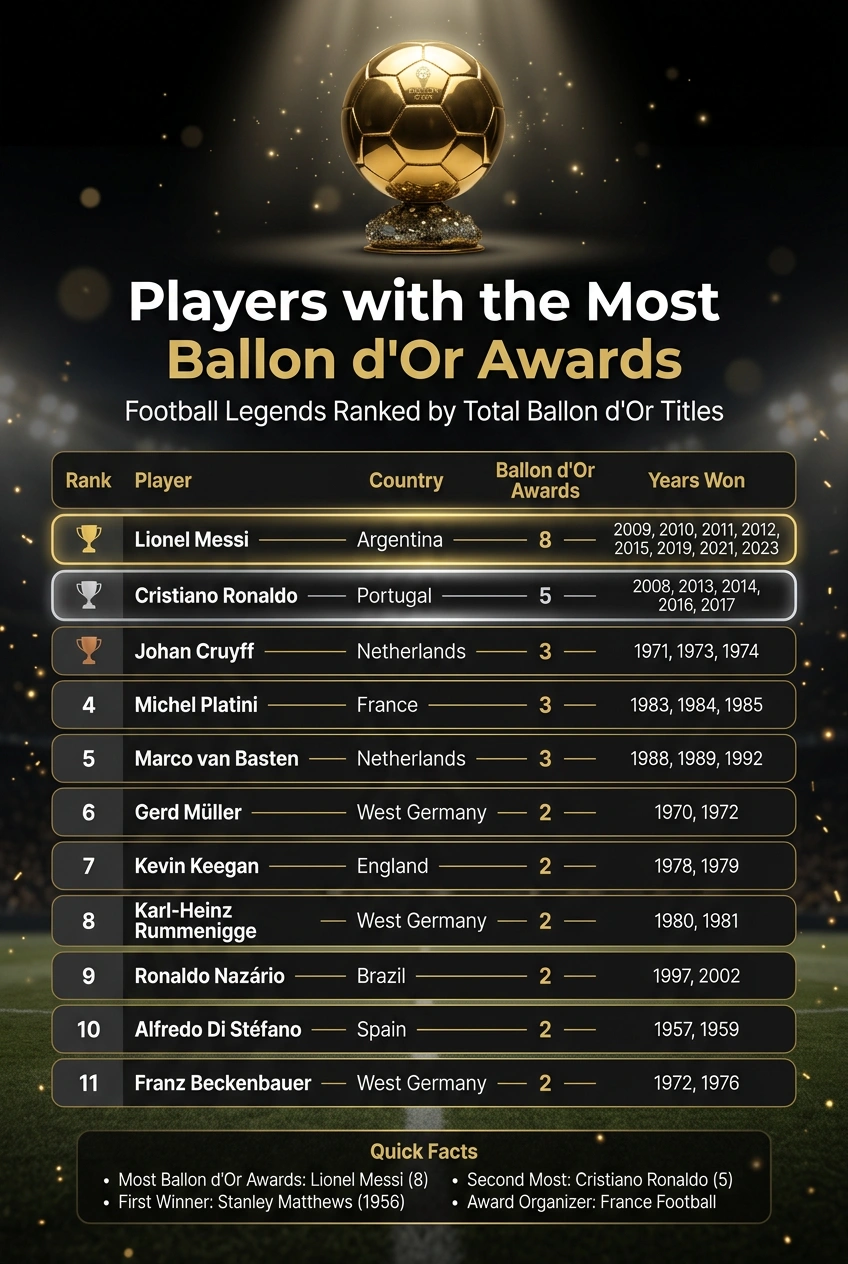
Players with the Most Ballon d’Or Awards
Some players have won the Ballon d’Or multiple times. This table shows the leaders.
| Player | Country | Total Awards | Years Won |
|---|---|---|---|
| Lionel Messi | Argentina | 8 | 2009-2024 |
| Cristiano Ronaldo | Portugal | 5 | 2008-2017 |
| Johan Cruyff | Netherlands | 3 | 1971-1974 |
| Michel Platini | France | 3 | 1983-1985 |
| Marco van Basten | Netherlands | 3 | 1988-1992 |
| Gerd Müller | West Germany | 2 | 1970-1972 |
| Kevin Keegan | England | 2 | 1978-1979 |
| Karl-Heinz Rummenigge | West Germany | 2 | 1980-1981 |
| Ronaldo | Brazil | 2 | 1997-2002 |
| Zinedine Zidane | France | 2 | 1998-2006 |
| Luís Figo | Portugal | 2 | 2000-2001 |
| Andriy Shevchenko | Ukraine | 2 | 2003-2004 |
| Ronaldinho | Brazil | 2 | 2004-2005 |
Messi’s eight awards stand alone at the top. Ronaldo’s five awards place him second. The gap between them and the next level shows how dominant these two players were for nearly two decades.
25 Greatest Argentine Players in Football History
FIFA World Cup Golden Boot Winners
Interesting Ballon d’Or Records
Youngest Winner
The youngest Ballon d’Or winner is Kaka, who was 25 years old when he won in 2007. However, if we count shared awards, some players were younger when they received recognition.
Oldest Winner
Alfredo Di Stéfano was in his early thirties when he won multiple awards in the late 1950s. Modern winners tend to peak in their late twenties to early thirties.
Most Consecutive Wins
Lionel Messi holds the record for most consecutive wins. He won four years in a row from 2009 to 2012. This streak showed complete dominance during Barcelona’s peak years.
Most Wins by Nationality
Argentina leads with 10 Ballon d’Or winners (Messi counts significantly toward this total). Brazil follows with multiple winners including Ronaldo and Ronaldinho. France has produced several winners as well.
Most Wins by Club
Barcelona dominated during the 2000s and 2010s with numerous winners including Ronaldinho, Messi, and others. Real Madrid also produced many champions, especially with Ronaldo and Cristiano.
Only Goalkeeper Winner
Lev Yashin won in 1963 as a goalkeeper. This remains unique. Modern goalkeepers almost never win because the award emphasizes attacking play.
Only Defender to Win
Franz Beckenbauer won in 1976. He was a sweeper with Barcelona-like defensive skills but also strong passing ability. No pure defender has won since.
Ballon d’Or Winners by Country and Club
The award rankings also show which nations and clubs have produced the most elite talent.
Wins by Country
This table shows the most successful nations in the history of the award.
| Country | Number of Wins | Winning Players |
|---|---|---|
| Argentina | 8 | Lionel Messi (8) |
| France | 7 | Raymond Kopa (1), Michel Platini (3), Jean-Pierre Papin (1), Zinedine Zidane (1), Karim Benzema (1) |
| Germany | 7 | Gerd Müller (1), Franz Beckenbauer (2), Karl-Heinz Rummenigge (2), Lothar Matthäus (1), Matthias Sammer (1) |
| Portugal | 7 | Eusébio (1), Luís Figo (1), Cristiano Ronaldo (5) |
| Netherlands | 7 | Johan Cruyff (3), Ruud Gullit (1), Marco van Basten (3) |
| Brazil | 5 | Ronaldo (2), Rivaldo (1), Ronaldinho (1), Kaká (1) |
| England | 5 | Stanley Matthews (1), Bobby Charlton (1), Kevin Keegan (2), Michael Owen (1) |
| Italy | 5 | Omar Sívori (1), Gianni Rivera (1), Paolo Rossi (1), Roberto Baggio (1), Fabio Cannavaro (1) |
| Spain | 4 | Alfredo Di Stéfano (2), Luis Suárez (1), Rodri (1) |
Note: Alfredo Di Stéfano is counted under Spain as he represented the country internationally when he won.
Wins by Club
This table lists the clubs that have had the most players win the trophy while wearing their shirt.
| Club | Number of Wins | Winning Players |
|---|---|---|
| Real Madrid | 12 | Alfredo Di Stéfano (2), Raymond Kopa (1), Luís Figo (1), Ronaldo (1), Fabio Cannavaro (1), Cristiano Ronaldo (4), Luka Modrić (1), Karim Benzema (1) |
| Barcelona | 12 | Luis Suárez (1), Johan Cruyff (2), Hristo Stoichkov (1), Rivaldo (1), Ronaldinho (1), Lionel Messi (6) |
| Juventus | 8 | Omar Sívori (1), Paolo Rossi (1), Michel Platini (3), Roberto Baggio (1), Zinedine Zidane (1), Pavel Nedvěd (1) |
| AC Milan | 8 | Gianni Rivera (1), Ruud Gullit (1), Marco van Basten (3), George Weah (1), Andriy Shevchenko (1), Kaká (1) |
| Bayern Munich | 5 | Gerd Müller (1), Franz Beckenbauer (2), Karl-Heinz Rummenigge (2) |
| Manchester United | 4 | Denis Law (1), Bobby Charlton (1), George Best (1), Cristiano Ronaldo (1) |
Why the Ballon d’Or Still Matters Today
In modern football, individual awards face criticism. Some argue that team success matters more than individual talent. The Ballon d’Or, however, remains meaningful for several reasons.
First, it provides global recognition. A player winning the award becomes instantly recognized worldwide. Their legacy grows stronger with each trophy.
Second, it bridges different leagues and countries. A player in Brazil, England, or Argentina can be recognized equally. This global perspective matters in a sport that spans all continents.
Third, it creates debate and engagement. Fans love arguing about awards. Social media discussion keeps football in people’s minds year-round, not just during seasons.
Finally, it acknowledges excellence in a sport that values teamwork. Despite being an individual award, winning the Ballon d’Or requires performing at the highest level alongside great teammates.
Frequently Asked Questions
Q1: Who has won the Ballon d’Or the most times?
A: Lionel Messi has won the Ballon d’Or eight times (2009, 2010, 2011, 2012, 2015, 2019, 2021, 2023). This is more than any other player in history. Cristiano Ronaldo is second with five awards.
Q2: When did the Ballon d’Or start?
A: The Ballon d’Or began in 1956. France Football magazine created the award to recognize the world’s best footballer. Stanley Matthews of England won the first award.
Q3: Has any goalkeeper won the Ballon d’Or?
A: Yes, Lev Yashin is the only goalkeeper to win. He won in 1963 while playing for Dynamo Moscow. No goalkeeper has won since, though several have been nominated.
Q4: Which country has produced the most Ballon d’Or winners?
A: Argentina has the most when counting Messi’s eight wins. France has produced several winners including Platini and Zidane. Brazil has also contributed many champions.
Q5: Do defenders ever win the Ballon d’Or?
A: Very rarely. Franz Beckenbauer is the only defender to win, in 1976. Modern football emphasizes attacking play, which makes defensive awards unlikely despite their importance to team success.
Q6: Why was there no Ballon d’Or in 2020?
A: The award was canceled due to COVID-19 disruptions. The global pandemic made it impossible to properly assess player performance across different league interruptions.
Q7: Can players from any country win?
A: Yes, the award is open to all nations. However, players from top European leagues dominate because their performances receive more coverage and voting attention.
Q8: How many voters choose the Ballon d’Or winner?
A: Thousands of voters participate, including journalists, coaches, and captains from around the world. The exact number has changed over the years, but modern voting is more democratic than historical voting.
Conclusion
The Ballon d’Or winners represent the very best of world football across nearly seven decades. From Stanley Matthews in 1956 to modern champions, the award has recognized incredible talent.
Lionel Messi’s eight awards stand as a remarkable achievement. His consistency and excellence across changing football landscapes earned him a place among the absolute greats. Cristiano Ronaldo’s five awards cemented his legacy as one of the most complete players ever.
Beyond the numbers, the Ballon d’Or tells football’s story. You can trace the evolution of tactics, playing styles, and global football development by looking at who won each year. Early European dominance gradually became more diverse. Modern awards increasingly recognize non-European excellence.
The award matters because it gives voice to excellence. In a sport where team success receives rightful emphasis, the Ballon d’Or honors individual brilliance and dedication. Winners carry this recognition for life.
Whether you agree with every winner or think certain selections were unfair, the Ballon d’Or remains football’s most prestigious individual award. It connects fans across nations and generations through shared debate about greatness.
What do you think about past Ballon d’Or winners? Do you have a controversial choice that still bothers you? Share your thoughts in the comments below. Football history is made through conversations like this.
Best Football Boots 2026 Top Picks for Speed
Top 10 Best-Paid Players at the World Cup 2026

1 comment