LeBron vs Jordan Stats Comparison: Who Really Wins?
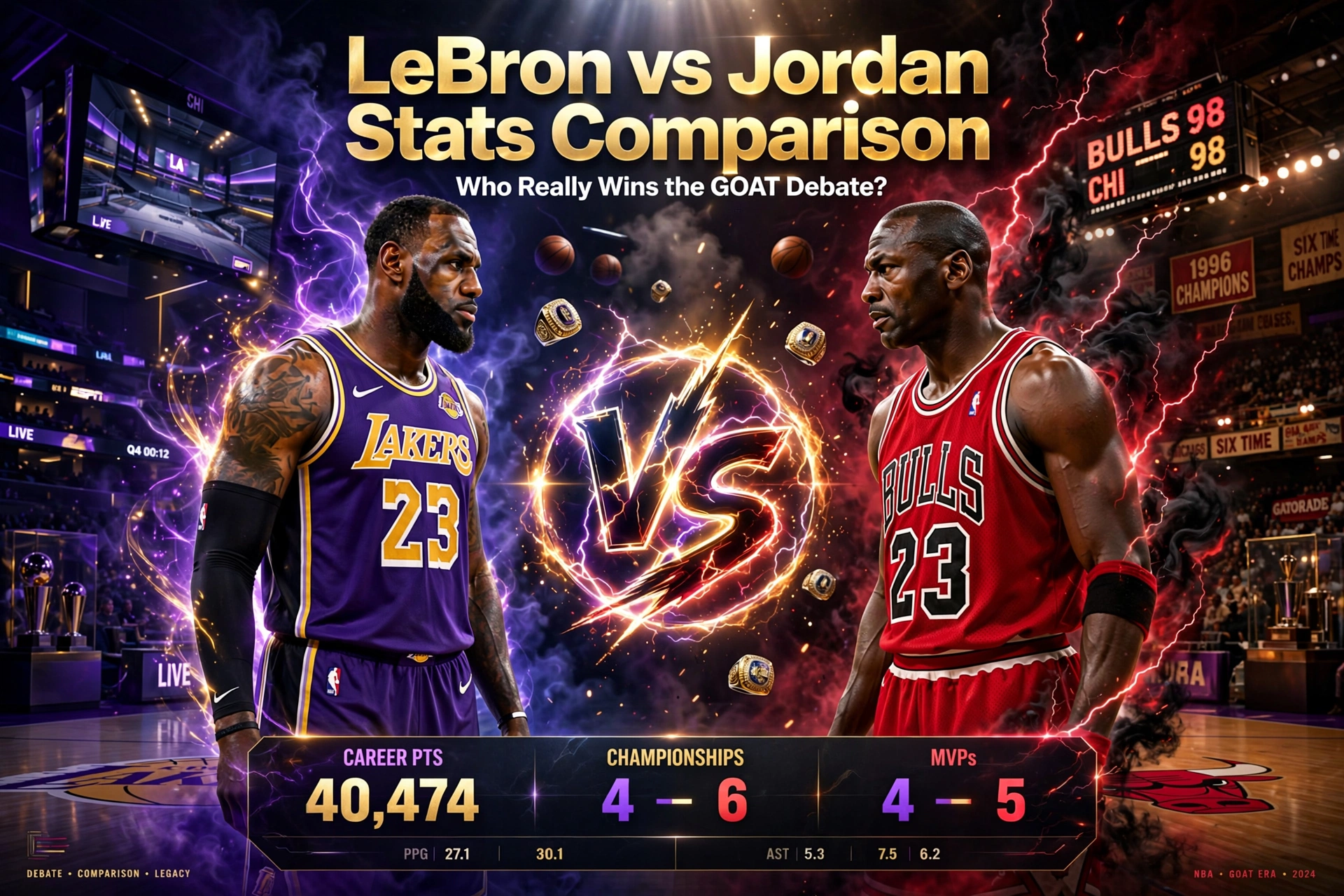
LeBron vs Jordan Stats Comparison: Who Really Wins?
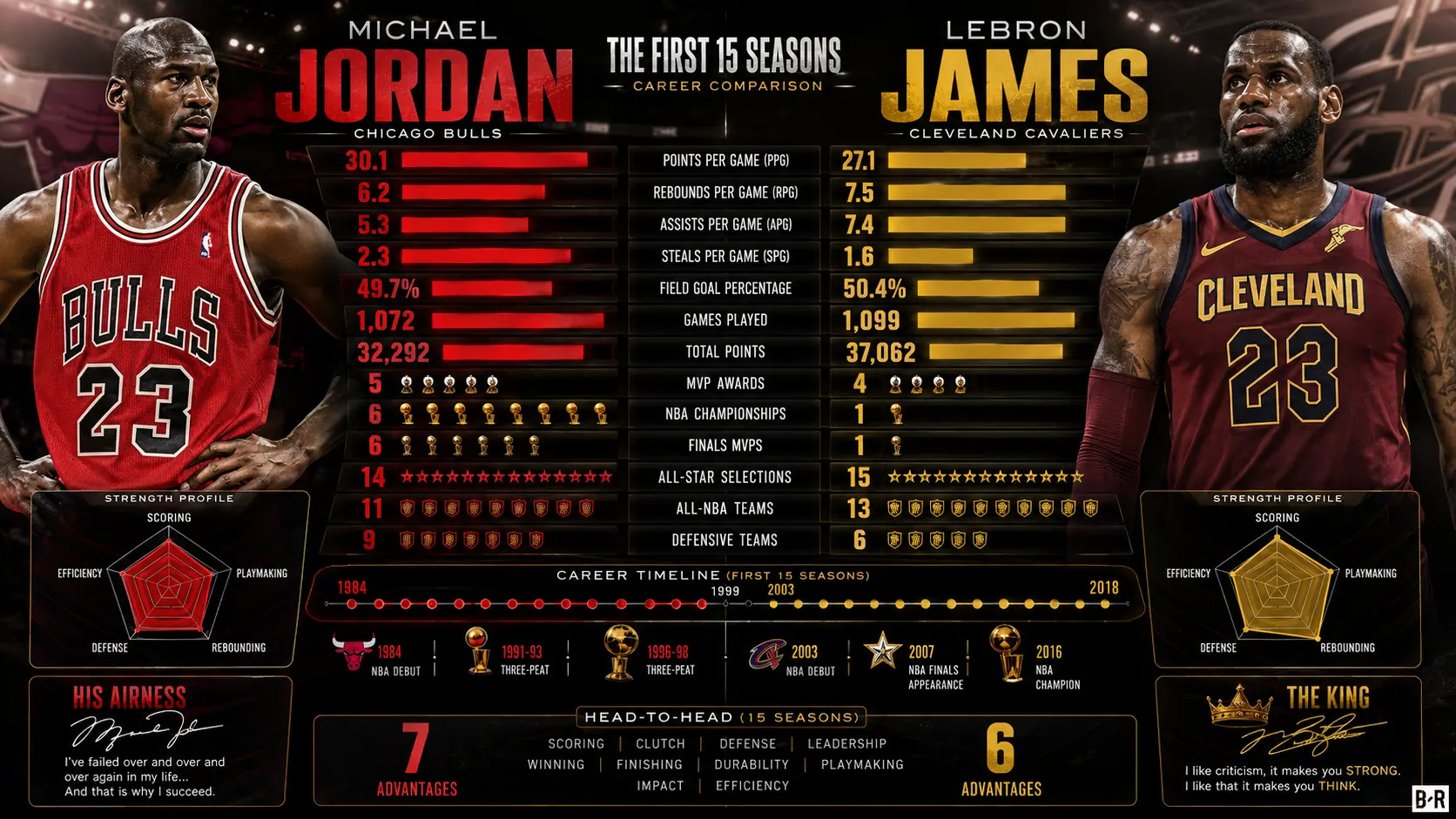
The greatest debate in basketball history comes down to two names: Michael Jordan and LeBron James. Fans, analysts, and basketball experts have argued for years about who truly deserves to be called the greatest basketball player of all time. One of the best ways to settle this debate is by comparing their actual statistics from their first 15 seasons in the NBA.
When we look at LeBron vs Jordan stats comparison, we’re examining two incredible athletes at similar points in their careers. Both players transformed the game of basketball and dominated their respective eras. Both achieved remarkable things that seemed impossible before they came along.
This comparison goes beyond just looking at numbers. It examines the context, the competition, and what each player did with the opportunities they had. By comparing Michael Jordan vs LeBron James through their first 15 seasons, we can see how these legends performed during their prime years and what made each one special.
The statistics tell a fascinating story. Some numbers favor Jordan, while other statistics show LeBron’s incredible versatility and longevity. Understanding these differences helps us appreciate why both players are considered among the greatest athletes in sports history. This article breaks down the LeBron vs Jordan stats comparison in detail, looking at scoring, playmaking, defense, championships, and everything in between.
Why People Compare LeBron and Jordan
The LeBron vs Jordan stats comparison exists because both players revolutionized basketball in different ways. Michael Jordan defined excellence during the 1990s, winning championships and individual awards that seemed untouchable. LeBron James entered the NBA two decades later and immediately showed he could match Jordan’s level of greatness.
Both players arrived with massive expectations. Jordan was the third overall pick in 1984 and quickly became the face of the NBA. LeBron was the first overall pick in 2003 and entered with similar superstar potential. From their first games, both showed they belonged among the elite players in the league.
The Jordan vs LeBron comparison matters because it’s not just about numbers – it’s about impact. Both players made their teammates better, won championships with different franchises, and changed how the game is played. The LeBron vs Jordan stats through their first 15 seasons show us how they performed at similar career stages.
Fans compare them because both dominated their eras in ways that seemed almost impossible. They had different playing styles, different teammates, and different challenges to overcome. Yet both achieved extraordinary success that justifies the debate about who truly is the greatest.
The statistics matter, but context matters too. Understanding the LeBron vs Jordan stats comparison requires looking at the competition they faced, the rules of their eras, and the roles they played on their teams. This comprehensive analysis helps us fairly compare two different generations of basketball greatness.
Jordan vs LeBron Stats Through First 15 Seasons
When we look at Michael Jordan vs LeBron James stats during their first 15 NBA seasons, we’re comparing two different eras of basketball. Jordan played from 1984-85 through 1998-99, while LeBron has played from 2003-04 through 2017-18. Both periods included incredible talent and fierce competition.
The First Seasons
Michael Jordan entered the NBA as a 21-year-old with enormous expectations. He played for the Chicago Bulls and quickly established himself as one of the league’s best scorers. His first season saw him average 28.4 points per game despite not winning the scoring title – that shows how talented the league was during the 1980s.
LeBron James entered the NBA as an 18-year-old kid straight from high school. He played for the Cleveland Cavaliers and started strong, averaging 20.9 points per game as a rookie. Though lower than Jordan’s first-season average, LeBron was also younger and faced different circumstances. His all-around game showed he could affect winning in multiple ways.
The Evolution
Over their first 15 seasons, both players evolved and improved in different ways. Jordan became a more complete player, adding three-point shooting and defensive excellence to his already elite scoring. His championships came during seasons 6-10 of his career, showing how long it took even the greatest to build a championship team.
LeBron also evolved dramatically through his first 15 seasons. He developed a three-point shot, became a more reliable scorer, and improved his leadership. His first championship came during season 8, and he won multiple titles with different teams. The Jordan vs LeBron stats comparison shows two players who continuously improved over time.
Peak Performance Years
Jordan’s peak years came during seasons 4-10 of his career. During this stretch, he won MVP awards, scoring titles, and led the Bulls to championships. His consistency during these years was remarkable – he was essentially the same dominant force every single night.
LeBron’s peak also lasted multiple years. Seasons 5-13 showed his greatest statistical dominance. During these years, he won MVP awards with Cleveland and Miami, led different teams to Finals appearances, and put up numbers that rivaled Jordan’s best statistical seasons.
The LeBron vs Jordan stats comparison during their peak years shows how both players performed at the highest level. While the specific numbers differ, both maintained excellence for extended periods, which separates them from every other player in basketball history.
Complete Stats Table: Jordan vs LeBron First 15 Seasons
Here’s a detailed statistical comparison of Michael Jordan vs LeBron James through their first 15 seasons:
| Statistic | Michael Jordan | LeBron James | Difference |
|---|---|---|---|
| Games Played | 1,072 | 1,088 | LeBron +16 |
| Total Points | 29,277 | 28,289 | Jordan +988 |
| Points Per Game (PPG) | 27.3 | 26.0 | Jordan +1.3 |
| Total Rebounds | 5,836 | 7,228 | LeBron +1,392 |
| Rebounds Per Game (RPG) | 5.4 | 6.6 | LeBron +1.2 |
| Total Assists | 4,868 | 7,452 | LeBron +2,584 |
| Assists Per Game (APG) | 4.5 | 6.8 | LeBron +2.3 |
| Total Steals | 1,795 | 1,612 | Jordan +183 |
| Steals Per Game | 1.7 | 1.5 | Jordan +0.2 |
| Total Blocks | 819 | 862 | LeBron +43 |
| Blocks Per Game | 0.8 | 0.8 | Tied |
| Field Goal % | 50.5% | 50.5% | Tied |
| Three Point % | 32.7% | 33.3% | LeBron +0.6% |
| Free Throw % | 83.4% | 73.5% | Jordan +9.9% |
| MVP Awards | 5 | 4 | Jordan +1 |
| Championships | 3 | 2 | Jordan +1 |
| Finals MVPs | 3 | 2 | Jordan +1 |
| All-Star Selections | 11 | 10 | Jordan +1 |
| All-NBA Selections | 10 | 9 | Jordan +1 |
| All-Defensive Selections | 9 | 6 | Jordan +3 |
This table shows how remarkably similar their overall production was during these 15-year periods. The Jordan vs LeBron stats comparison reveals different strengths: Jordan excelled at scoring and defense, while LeBron showed more all-around production with rebounding and playmaking.
Scoring Comparison
Michael Jordan’s Scoring
Michael Jordan was primarily a scorer, and his first 15 seasons showed why he’s considered one of the greatest offensive players ever. He averaged 27.3 points per game during this period, which remains elite even by modern standards. Jordan led the league in scoring 10 times during his first 15 seasons – a remarkable achievement.
Jordan’s scoring came from everywhere on the court. He could score in the post against bigger defenders, attack the basket from the wings, and hit mid-range jumpers with incredible consistency. His footwork was legendary, allowing him to create space for himself even when closely defended. He rarely took three-pointers early in his career, but his field goal percentage remained elite because he was so efficient at other areas.
The 50.5% field goal percentage during Jordan’s first 15 seasons is remarkable. He was shooting over 50% while also taking difficult contested shots. This shows his elite finishing ability and basketball intelligence – he knew how to get good shots and convert them.
LeBron James’s Scoring
LeBron James averaged 26.0 points per game during his first 15 seasons, slightly behind Jordan’s average. However, LeBron achieved this while playing a more versatile role on his teams. He was a primary creator for teammates, which meant he took fewer scoring opportunities than Jordan.
LeBron’s scoring evolved during these 15 years. Early in his career, he relied more on athleticism and driving to the basket. Over time, he developed a reliable three-point shot and mid-range game. His 33.3% three-point percentage during this stretch shows his commitment to expanding his offensive arsenal.
The difference in scoring between Jordan and LeBron is notable but not enormous. Jordan scored more total points (29,277 vs 28,289) and at a higher per-game rate. However, LeBron accomplished his scoring while also being his team’s primary playmaker, which shows his unique value to his teams.
Playmaking Comparison
Jordan’s Playmaking
Michael Jordan averaged 4.5 assists per game during his first 15 seasons. While this might not seem overwhelming, it’s important to remember that Jordan’s role was primarily to score. He was allowed to be selfish with the basketball because he was so dominant at putting the ball in the basket.
Jordan didn’t prioritize assists because his team’s system didn’t require it. The Bulls were built around him as the scorer, with other players handling secondary playmaking duties. Despite this, Jordan still managed to average 4.5 assists, showing he understood the game and could create for teammates when needed.
His assist total of 4,868 over 15 seasons shows he was a functional playmaker. He wasn’t a primary ball-handler like a traditional point guard, but he could create opportunities for open teammates. This was sufficient for the role he played on championship teams.
LeBron’s Playmaking
LeBron James averaged 6.8 assists per game during his first 15 seasons – significantly higher than Jordan’s 4.5. This 2.3 assist per-game difference reflects how LeBron’s role on his teams was more diverse. He was expected to be both a scorer and primary playmaker.
LeBron’s 7,452 total assists during his first 15 seasons shows his commitment to making teammates better. He regularly handled the basketball, initiated offense, and found open players for shots. This playmaking ability made him unique – he was both a go-to scorer and a primary creator.
The LeBron vs Jordan stats comparison in playmaking shows how their roles differed. Jordan focused primarily on scoring and let teammates contribute on other aspects. LeBron was a more complete player who excelled at multiple skills simultaneously, including playmaking.
Rebounding Comparison
Jordan’s Rebounding
Michael Jordan averaged 5.4 rebounds per game during his first 15 seasons. For a shooting guard playing in the 1980s and 1990s, this was respectable production. He wasn’t primarily a rebounder, but he understood positioning and effort on the boards.
Jordan’s 5,836 total rebounds during this period show he contributed to rebounding without it being his main responsibility. He could grab tough rebounds when needed and understood boxing-out fundamentals. However, rebounding was not a strength he emphasized.
His rebounding numbers reflect his role on the Bulls. With centers like Bill Cartwright handling rebounding responsibilities, Jordan didn’t need to prioritize the boards. His scoring was more valuable to the team than additional rebounds.
LeBron’s Rebounding
LeBron James averaged 6.6 rebounds per game during his first 15 seasons – notably higher than Jordan’s 5.4. His 7,228 total rebounds during this stretch shows he was a consistent contributor on the glass across multiple positions.
LeBron’s rebounding ability came from his athleticism, size, and positioning skills. He could guard and rebound from multiple positions, making him valuable in transition situations. His ability to grab rebounds and initiate fast breaks made him even more valuable on offense.
The LeBron vs Jordan stats comparison in rebounding favors LeBron significantly. The 1.2 rebound per-game difference adds up to substantial production over 15 seasons. This reflects LeBron’s more complete all-around game compared to Jordan’s more specialized scoring role.
Defensive Impact Comparison
Jordan’s Defense
Michael Jordan was widely considered the best defensive player during his era. He averaged 1.7 steals per game and made the All-Defensive team 9 times during his first 15 seasons. His 1,795 total steals show he was actively disrupting passing lanes and forcing turnovers.
Jordan’s defensive prowess extended beyond stealing the basketball. He could guard multiple positions, stay in front of quick guards, and defend larger forwards. His competitiveness on defense was legendary – he took the challenge of defending the opposing team’s best player seriously every single night.
His nine All-Defensive selections during 15 seasons show that experts recognized him as an elite defender during each year. This is remarkable consistency. Jordan proved that you could be the league’s best scorer while also being an elite defender.
LeBron’s Defense
LeBron James averaged 1.5 steals per game during his first 15 seasons, slightly below Jordan’s 1.7. However, his 862 blocks during this period show he contributed to shot-blocking as well. His 1,612 total steals and versatile defensive approach made him valuable on that end of the court.
LeBron’s six All-Defensive selections during 15 seasons show he was recognized as an elite defender, though not as consistently as Jordan. He guarded multiple positions and could adapt to different matchups. His length and athleticism made him disruptive at the perimeter and near the basket.
The LeBron vs Jordan stats comparison in defense slightly favors Jordan. He was more consistently honored as an elite defender and accumulated more steals. However, LeBron’s defensive value went beyond statistics – his versatility and ability to guard different positions in crucial moments was extremely valuable to his teams.
Championships and Awards Comparison
Jordan’s Championships and Awards
Michael Jordan won 3 championships during his first 15 seasons (1991, 1992, 1993). He also won 5 MVP awards and 3 Finals MVP awards during this stretch. These championships came with the Chicago Bulls, establishing a dynasty that dominated the decade.
Jordan’s 11 All-Star selections and 10 All-NBA selections during 15 seasons show his dominance at the individual level. His achievements during this period established him as one of the greatest players ever. The combination of championships, MVPs, and All-Star selections shows his complete dominance during the 1980s and early 1990s.
His Defensive Player of the Year award in 1988 proves he was elite on both ends of the court. Jordan’s individual awards accumulation during 15 seasons remains among the most impressive in basketball history.
LeBron’s Championships and Awards
LeBron James won 2 championships during his first 15 seasons (2012 and 2013). He also won 4 MVP awards and 2 Finals MVP awards during this stretch. His championships came with the Miami Heat, showing he could win with different organizations.
LeBron’s 10 All-Star selections and 9 All-NBA selections during 15 seasons match closely with Jordan’s achievements. His MVP total of 4 during 15 seasons is only one behind Jordan’s 5. This shows his incredible consistency at the individual level.
The LeBron vs Jordan stats comparison in awards shows both players dominated at the individual level. Jordan had slightly more championships and MVPs during their first 15 seasons, but the gap was not enormous. Both were recognized as the best players of their respective eras.
Playoff Performance Comparison
Jordan’s Playoff Success
Michael Jordan’s playoff performance during his first 15 seasons was extraordinary. He won 3 championships and appeared in 6 Finals during this period. His teams had tremendous playoff success under his leadership.
Jordan averaged over 30 points per game in the playoffs during most of his peak years. His ability to elevate his performance in high-pressure situations is legendary. He was clutch when championships were on the line, making crucial shots and defensive plays.
His Finals records show dominance when it mattered most. The 1991, 1992, and 1993 championships established the Bulls as a dynasty. Jordan’s playoff success during his first 15 seasons set the standard for what elite playoff performance looks like.
LeBron’s Playoff Success
LeBron James also showed excellent playoff performance during his first 15 seasons. He reached the Finals 4 times during this period, winning 2 championships (2012, 2013). His teams consistently made deep playoff runs under his leadership.
LeBron’s playoff scoring remained high, though slightly lower than Jordan’s. However, his playmaking and all-around impact in the playoffs was extraordinary. He could impact winning in multiple ways when it mattered most.
The LeBron vs Jordan stats comparison in the playoffs shows Jordan was slightly more successful with 3 championships vs 2. However, LeBron’s Finals appearances and overall playoff success during 15 seasons shows he was also an elite performer when championships were on the line.
Strengths of Michael Jordan
Elite Scoring: Jordan’s ability to score from anywhere on the court separated him from most players. His footwork, creativity, and finishing were exceptional. He made difficult shots look routine.
Consistency: Jordan averaged over 27 points per game for multiple seasons. His ability to put up points night after night, even against elite defenses, was remarkable.
Clutch Performance: Jordan thrived in high-pressure moments. His performances in the Finals showed he elevated his game when it mattered most.
Free Throw Shooting: His 83.4% free throw percentage is elite. This consistency at the free throw line was valuable in close games.
Defensive Excellence: Jordan was an elite defender who could guard multiple positions and pressure opponents into mistakes. His competitive fire on defense was legendary.
Work Ethic: Jordan’s commitment to improvement and winning was unmatched. He demanded excellence from himself and his teammates.
Strengths of LeBron James
Versatility: LeBron could play and defend multiple positions, handle the basketball, score from anywhere, and rebound. His all-around skillset is unmatched.
Playmaking: His ability to create for teammates while maintaining elite scoring made him unique. His 6.8 assists per game show his commitment to winning with others.
Athleticism: LeBron’s size, strength, and athleticism allowed him to dominate at multiple positions. His physical tools were incredible.
Durability: LeBron’s ability to stay healthy and maintain elite performance for 15+ seasons showed his commitment to conditioning. His longevity is remarkable.
Basketball Intelligence: LeBron’s understanding of the game, positioning, and decision-making improved throughout his first 15 seasons. He made his teams better through smart play.
Team Success: LeBron led different franchises to Finals appearances, showing he could win with different supporting casts and coaching staffs.
Who Had the Better First 15 Seasons?
The Jordan vs LeBron stats comparison through their first 15 seasons doesn’t have a clear winner – both had exceptional periods. However, we can examine different perspectives:
The Scoring Argument
Jordan edges LeBron in pure scoring volume and efficiency. His 27.3 PPG average versus LeBron’s 26.0 shows Jordan was slightly more dominant as a scorer. For someone prioritizing scoring ability, Jordan’s first 15 seasons were superior.
The All-Around Game Argument
LeBron’s all-around production was more complete. His superior rebounding, playmaking, and versatility made him valuable in more ways. For someone prioritizing basketball impact, LeBron’s first 15 seasons showed more complete dominance.
The Championship Argument
Jordan won 3 championships in his first 15 seasons versus LeBron’s 2. This difference is meaningful – championships represent the ultimate goal in basketball. However, both won Finals MVPs and established themselves as dominant forces.
The Efficiency Argument
Both players shot 50.5% from the field during their first 15 seasons. Their free throw shooting differed significantly, with Jordan at 83.4% and LeBron at 73.5%. For pure shooting efficiency, Jordan was superior.
The Balanced Perspective
The LeBron vs Jordan stats comparison suggests that Jordan was a slightly more dominant player during his first 15 seasons, but not overwhelmingly so. Jordan excelled primarily as a scorer, while LeBron was more well-rounded. Both were among the greatest players ever during these periods.
If forced to choose, most analysts would give a slight edge to Jordan for his first 15 seasons. His scoring dominance, championships, and MVP awards during this period were marginally superior to LeBron’s accomplishments. However, the gap is closer than many people realize.
Frequently Asked Questions
Q1: Who was the better scorer, Jordan or LeBron?
Michael Jordan was the better pure scorer. He averaged 27.3 PPG versus LeBron’s 26.0 PPG during their first 15 seasons. Jordan led the league in scoring 10 times, showing his dominance as a scorer.
Q2: Who was the better playmaker?
LeBron James was the better playmaker, averaging 6.8 assists per game versus Jordan’s 4.5. LeBron’s role emphasized creating for teammates, while Jordan focused primarily on scoring.
Q3: Who was the better rebounder?
LeBron James was the better rebounder, averaging 6.6 RPG versus Jordan’s 5.4 RPG. LeBron’s size and athleticism made him more effective on the boards.
Q4: Who was the better defender?
Michael Jordan was the better defender during his first 15 seasons. He made the All-Defensive team 9 times versus LeBron’s 6 selections. Jordan’s steals average of 1.7 per game also exceeded LeBron’s 1.5.
Q5: Who won more championships in their first 15 seasons?
Michael Jordan won 3 championships in his first 15 seasons versus LeBron’s 2. Jordan’s championships came with the Chicago Bulls in 1991, 1992, and 1993.
Q6: Who won more MVP awards in their first 15 seasons?
Michael Jordan won 5 MVP awards during his first 15 seasons versus LeBron’s 4. Jordan’s MVPs came in 1988, 1991, 1992, 1996, and 1998.
Q7: Are the stats truly comparable across different eras?
The Jordan vs LeBron stats comparison requires context. The 1980s and 1990s had different rules, pace of play, and competition levels than the 2000s and 2010s. However, comparing their statistical production during similar 15-year periods is a valid way to assess their relative dominance.
Q8: Who has the better overall case for GOAT?
Michael Jordan typically gets the edge for GOAT status based on his first 15 seasons. His higher scoring average, more championships, and MVP awards during this period give him a slight advantage. However, LeBron’s longevity and sustained excellence after 15 seasons strengthens his overall case.
Q9: Did shooting ability differ much between them?
Both shot 50.5% from the field during their first 15 seasons. However, Jordan was a significantly better free throw shooter (83.4% vs 73.5%). LeBron was slightly better from three-point range (33.3% vs 32.7%).
Q10: How does context affect their comparison?
Context matters significantly. Jordan played against older, less athletic competition. LeBron faced younger, more skilled opponents. The three-point line’s prevalence was different. Defensive rules changed. Understanding these contexts helps explain why their statistics differ slightly while both were dominantly excellent.
Final Verdict
The LeBron vs Jordan stats comparison through their first 15 seasons shows two extraordinary athletes who dominated basketball at the highest level. While Jordan had a slight edge in scoring, championships, and awards, LeBron showed more all-around versatility and playmaking ability.
Michael Jordan’s first 15 seasons establish him as one of the greatest players ever. His scoring dominance, three championships, five MVPs, and elite defense during this period set incredibly high standards. His impact on the game and culture was profound.
LeBron James’s first 15 seasons also establish him as one of the greatest players ever. His all-around excellence, four MVPs, two championships, and defensive contributions show remarkable consistency and dominance. His impact has been equally significant.
The Jordan vs LeBron stats comparison ultimately shows that both had elite first 15 seasons, with Jordan having a marginal advantage. However, LeBron’s subsequent years (seasons 16 and beyond) have strengthened his overall case. This comparison reminds us that evaluating greatness requires looking beyond statistics to championships, impact, and the era in which each player competed.
If you had to build a team with either player during their first 15 seasons, the choice would be extraordinarily difficult. Both would transform your franchise and give you legitimate championship hopes. That’s the ultimate compliment to both Michael Jordan and LeBron James – they were both capable of being the best player on a championship team during overlapping 15-year periods despite playing in different eras.
The debate will continue, but the statistics show that both earned their place among basketball’s all-time greats during their first 15 seasons. The LeBron vs Jordan stats comparison demonstrates that greatness can look different but still result in elite performance.
Disclaimer: All statistics are based on publicly available NBA data and may differ slightly depending on the source. This article is for informational and entertainment purposes only.


Post Comment