Argentina vs Germany Football Head-to-Head Complete Match History, Stats, Records
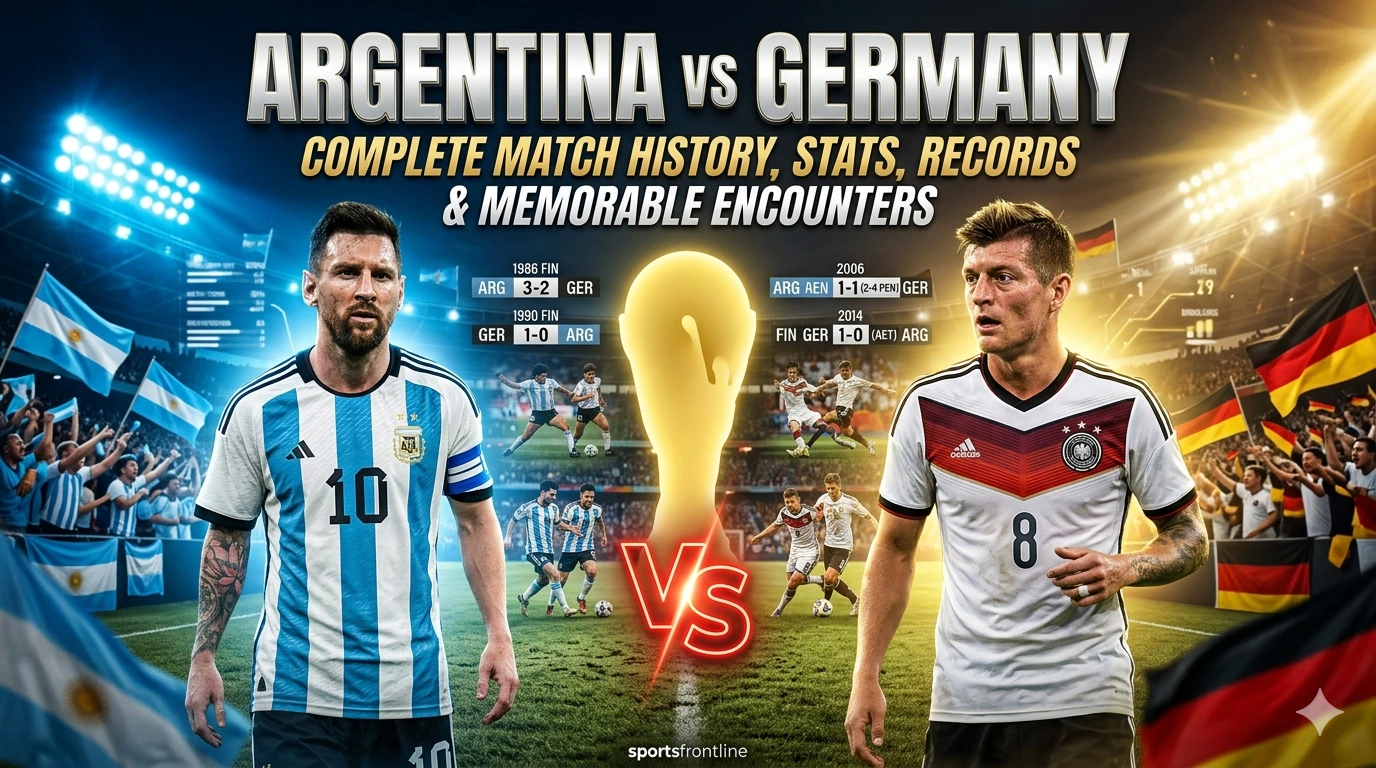
Argentina vs Germany Football Head-to-Head: Complete Match History, Stats, Records & Memorable Encounters
Some football rivalries are born out of geography. Some grow from political tensions. And then there’s Argentina versus Germany — a rivalry forged entirely in the fires of football’s biggest stage. Argentina vs Brazil Head to Head
These two nations have given us three World Cup finals, penalty shootout heartbreak, Mario Götze’s extra-time winner, Maradona’s genius, and a level of tactical chess that has educated football fans for decades. Whether you call them Die Mannschaft or La Albiceleste, when these two sides meet, something special almost always happens.
This isn’t just a rivalry between two football teams. It’s a clash of two footballing philosophies — the fluid, passionate, individual brilliance of South America against the organized, relentless, collective machine of Europe. And in that tension, magic gets made.
So let’s break it all down. From the very first meeting to the most recent encounter, here is the complete Argentina vs Germany head-to-head story.
Argentina vs Germany Head-to-Head Overview
Before diving into the stories, let’s look at where the numbers stand. Over their entire competitive and friendly history, Argentina and Germany have met a combined total of 24 times (as of 2024).
| Stat | Figure |
|---|---|
| Total Matches Played | 24 |
| Argentina Wins | 10 |
| Germany Wins | 10 |
| Draws | 4 |
| Goals Scored by Argentina | 41 |
| Goals Scored by Germany | 42 |
| World Cup Meetings | 7 |
| World Cup Finals | 3 |
It’s almost poetic how even the head-to-head record looks. Ten wins each, a virtually identical goals tally, and four draws. On paper, you genuinely cannot separate these two teams — and that’s exactly what makes every match between them feel like must-watch television.
The History of the Argentina vs Germany Rivalry
How It All Began
The two nations first crossed paths in the 1958 World Cup in Sweden, a group-stage match that West Germany won 3-1. At that point, nobody could have imagined what this fixture would eventually become. Argentina were still finding their feet as a world power, and West Germany — just four years on from their famous Miracle of Bern — were already establishing themselves as European heavyweights.
Through the 1960s and 1970s, the rivalry simmered rather than boiled. The real heat came when the World Cup started serving up increasingly high-stakes meetings between the two sides.
Argentina’s 1978 World Cup triumph on home soil, while not involving a Germany encounter, set them up as genuine world-class contenders. By the time the 1980s arrived, the stage was set for something historic.
The 1986 Turning Point
If there was one moment that truly elevated this fixture to the status of an all-time great rivalry, it was the 1986 World Cup Final in Mexico City. Maradona versus the Germans. Argentina’s creativity against West Germany’s discipline. It had everything — and it delivered everything too.
That match didn’t just produce a result. It produced a mythology that still shapes how we talk about both nations.
The Evolution Through the 90s and 2000s
Through the 1990s and 2000s, both nations evolved their styles considerably. Argentina moved through periods of tactical discipline under Bilardo, flair under Basile, and a more defensive edge under Passarella. Germany went through reunification, a period of transition, and eventually a remarkable rebuild that produced one of the most complete international sides the game has ever seen.
Argentina vs Germany in FIFA World Cup History
1986 FIFA World Cup Final — Mexico City
Result: Argentina 3-2 West Germany
This is where the rivalry truly announced itself to the world. Playing at the Estadio Azteca in front of over 114,000 fans, Argentina produced one of the finest World Cup Final performances in history.
Diego Maradona hadn’t scored in the final itself, but his presence — his movement, his creativity, his ability to drag defenders out of position — was everywhere. José Luis Brown opened the scoring in the 23rd minute. Jorge Valdano made it 2-0 shortly after the break, and the Cup seemed destined for Buenos Aires.
Then West Germany did what West Germany always do — they refused to quit. Karl-Heinz Rummenigge and Rudi Völler both scored to level the tie at 2-2 and send the final into nervous territory.
But then came Jorge Burruchaga. Six minutes from time, Maradona — the man who had dominated the entire tournament with that hand of god, that goal of the century — played a perfectly weighted through ball that Burruchaga ran onto and slotted past goalkeeper Toni Schumacher.
Argentina 3-2 West Germany. The trophy was theirs, and Maradona was a god.
Why it matters: This remains one of the most celebrated World Cup Finals ever played. It gave the world Maradona as a global superstar, and it gave Argentina their second world title.
1990 FIFA World Cup Final — Rome
Result: West Germany 1-0 Argentina
Few finals in World Cup history have been as controversial — or as bitterly contested — as this one.
Argentina came into the 1990 World Cup Final as defending champions but were a shell of the 1986 side. Injuries had taken their toll, and the squad was more functional than inspired. Maradona was there, but he was carrying a significant ankle problem and was well below his best. Best Defenders in Football World Cup 2026
West Germany, by contrast, were peaking. Franz Beckenbauer’s side were organized, efficient, and ruthless. They had arguably the best squad in the world at that point.
The match itself was a poor spectacle. Tackles flew in, tension ran high, and Argentina had two players sent off — Pedro Monzón became the first player in World Cup Final history to receive a red card.
The decisive moment came from the penalty spot in the 85th minute. West Germany were awarded a controversial penalty — even some German fans felt it was soft — and Andreas Brehme stepped up to convert it. Argentina couldn’t respond with ten men, and the Cup went to Germany.
Why it matters: The controversy of the penalty, the red cards, and the bitter nature of the defeat gave Argentina a sense of unfinished business that would define the rivalry for years to come.
2006 FIFA World Cup Quarter-Final — Berlin
Result: Germany 1-1 Argentina (Germany win 4-2 on penalties)
Twenty years after Maradona’s masterclass, a new generation of Argentina stars — led by a young Lionel Messi — arrived at the 2006 World Cup in Germany. The quarter-final clash between the hosts and Argentina was electric from the very first minute.
Roberto Ayala gave Argentina the lead, and for long stretches it looked like the Albiceleste would advance. But Miroslav Klose equalized with 12 minutes to go, forcing extra time and then penalties.
The shootout was agony for Argentina. Ayala and Cambiasso both missed for Argentina, while Germany converted four from four. Germany went through, and Jürgen Klinsmann’s side eventually finished third in the tournament.
Why it matters: It showed how dramatically the balance of power had shifted. Germany, playing at home, were now a genuine match for Argentina at their best, and the penalty shootout drama added another chapter to the story.
2010 FIFA World Cup Quarter-Final — Cape Town
Result: Germany 4-0 Argentina
If the 2006 quarter-final had been tight and dramatic, the 2010 version was a completely different story — and it shocked the football world.
Lionel Messi, by this point widely regarded as the best player on the planet, was utterly nullified by Joachim Löw’s Germany side. The scoreline doesn’t lie — 4-0 was a comprehensive, dominant, slightly stunning victory for Germany. Müller scored twice. Klose scored. Cacau added a fourth.
Diego Maradona was Argentina’s manager and his tactics were simply overrun. The 4-2-3-1 that Germany deployed was a masterclass in pressing, width, and transition. Argentina simply had no answer.
Why it matters: This result is significant because it’s the biggest World Cup defeat Argentina have suffered against Germany. It also raised serious questions about whether Messi could lead Argentina to a World Cup — a debate that wouldn’t be settled for another 12 years.
2014 FIFA World Cup Final — Rio de Janeiro
Result: Germany 1-0 Argentina (AET)
The Maracanã. 13 July 2014. Over 74,000 fans inside the stadium, and what felt like the entire planet watching on screens around the world. This was Argentina vs Germany in a World Cup Final for the third time — and it did not disappoint.
Germany had been extraordinary throughout the tournament. The 7-1 semi-final demolition of hosts Brazil had left the world speechless. Argentina had been more cautious, with Messi carrying them through several tight knockout matches.
For 113 minutes, neither side could break the deadlock. Both goalkeepers — Manuel Neuer for Germany, Sergio Romero for Argentina — produced saves that kept the tie alive. Higuaín missed a clear chance. Palacio scooped over. Germany hit the post.
Then, seven minutes from the end of extra time, substitute Mario Götze received a cross from André Schürrle on his chest, controlled it with sublime touch, and swept a left-footed volley past Romero. It was a goal worthy of winning any World Cup Final.
Germany 1-0 Argentina. Their fourth world title. Their first as a unified Germany.
Why it matters: This was Messi’s best chance at a World Cup title — the one that got away. For many, it defined the Messi-versus-Maradona debate for years. It also completed a remarkable symmetry: Argentina and Germany had now met in three World Cup Finals with each side winning one and a third deciding a title between them.
Most Memorable Argentina vs Germany Matches
Beyond the World Cup Finals, this rivalry has produced some genuinely brilliant club-level and international matches. Here are five encounters that deserve special mention:
1. 1986 World Cup Final (Argentina 3-2 West Germany) — The Maradona masterclass that defined an era.
2. 2014 World Cup Final (Germany 1-0 Argentina) — Götze’s moment of genius on the grandest stage.
3. 2010 World Cup Quarter-Final (Germany 4-0 Argentina) — The match that shocked a generation of Argentina fans.
4. 2006 World Cup Quarter-Final (Germany 1-1 Argentina, Germany on pens) — Drama, tension, heartbreak for Argentina in Berlin.
5. 2010 Friendly (Argentina 3-1 Germany) — A pre-World Cup friendly in Munich where Maradona’s Argentina humiliated the hosts on their own turf, with Angel Di María and Gabriel Heinze scoring in a memorable 3-1 win. A rare comfortable victory and one fans still cite.
Legendary Players Who Defined the Rivalry
Diego Maradona
The man who won Argentina’s 1986 World Cup against West Germany almost single-handedly. His through ball for Burruchaga’s winner in the final is one of football’s greatest assists. Maradona later managed Argentina in 2010, and while that didn’t end well, his connection to this rivalry is eternal.
Lionel Messi
Three World Cup meetings with Germany, including the 2014 final. Messi was eventually awarded the Golden Ball for best player at that tournament — a decision still debated. He finally got his World Cup in 2022, though not against Germany. His rivalry with this fixture remains unresolved in emotional terms.
Mario Götze
He came on as a substitute in extra time of the 2014 World Cup Final, and within minutes had scored one of the most technically brilliant goals in World Cup Final history. Forever a hero in Germany, forever a painful memory for Argentina.
Miroslav Klose
Germany’s all-time World Cup top scorer with 16 goals. Scored against Argentina in both the 2006 and 2010 World Cup knockout rounds. A consistent, reliable, and deeply important player in these encounters.
Franz Beckenbauer
Managed West Germany to the 1990 World Cup title against Argentina, having also captained the side that lost the 1986 final. Der Kaiser is one of the most significant figures in this entire rivalry on the German side.
Lothar Matthäus
Arguably Germany’s greatest-ever player. Featured in multiple matches against Argentina, including the 1990 final where he was the heartbeat of the German midfield. A warrior and a genius. Brazil vs Germany Head to Head Record All Time
Gabriel Batistuta
Argentina’s greatest striker of the 1990s. Batigol scored consistently against European opposition and, while a World Cup title eluded him, his performances against Germany in various tournaments were commanding.
Thomas Müller
One of the modern rivalry’s great tormentors of Argentina. Scored twice in the 2010 quarter-final and has been a constant thorn in Argentina’s side whenever the two nations have met in recent years.
Tactical Comparison: Two Football Philosophies
Argentina’s Style
Argentina have traditionally been built around individual brilliance. From Maradona’s street-smart genius to Messi’s quiet, devastating efficiency, La Albiceleste have usually had one transcendent talent around whom the team is built. They are tactically flexible but emotionally intense — at their best when fuelled by passion and freedom.
Their weaknesses have historically been vulnerability in transition and over-reliance on individual moments to break down organized defenses. When the star player is neutralized, Argentina can struggle.
Germany’s Style
Germany are the textbook example of collective organization above individual excellence. That doesn’t mean they lack stars — Müller, Klose, Matthäus, Beckenbauer are all legends of the game — but the German system has always been built to function even when individual players have off-nights.
Their strengths are pressing intensity, physical dominance, tactical discipline, and the ability to manage high-pressure situations. Their relative weakness — at least in the modern era — has been creativity and unpredictability.
In summary: Argentina bring the art, Germany bring the science. When those two things collide at full intensity, you get the kind of matches that end up on “greatest games ever” lists.
Argentina vs Germany Statistics and Records
World Cup Head-to-Head
| Year | Stage | Result | Venue |
|---|---|---|---|
| 1958 | Group Stage | West Germany 3-1 Argentina | Malmö, Sweden |
| 1966 | Group Stage | West Germany 0-0 Argentina | Birmingham, England |
| 1986 | Final | Argentina 3-2 West Germany | Mexico City |
| 1990 | Final | West Germany 1-0 Argentina | Rome |
| 2006 | Quarter-Final | Germany 1-1 Argentina (4-2 pens) | Berlin |
| 2010 | Quarter-Final | Germany 4-0 Argentina | Cape Town |
| 2014 | Final | Germany 1-0 Argentina (AET) | Rio de Janeiro |
Top Scorers in the Rivalry
| Player | Nation | Goals |
|---|---|---|
| Miroslav Klose | Germany | 3 |
| Thomas Müller | Germany | 3 |
| Jorge Valdano | Argentina | 2 |
| Rudi Völler | West Germany | 2 |
| Gabriel Batistuta | Argentina | 2 |
Biggest Victories
| Match | Result | Year |
|---|---|---|
| Germany vs Argentina | 4-0 | 2010 World Cup |
| West Germany vs Argentina | 3-1 | 1958 World Cup |
| Argentina vs West Germany | 3-2 | 1986 World Cup Final |
15 Key Facts About the Argentina vs Germany Rivalry
- Argentina and Germany are the only two nations to have faced each other in three World Cup Finals (1986, 1990, 2014).
- Germany won the 2014 World Cup Final with a substitute’s goal in extra time — Mario Götze, who came on in the second half of extra time.
- The 1990 World Cup Final remains one of the most controversial in history, with many arguing the decisive penalty should never have been given.
- In the 2010 World Cup quarter-final, Messi had zero shots on target — one of his worst World Cup performances.
- The overall head-to-head record is almost perfectly even: 10 wins each with 4 draws (as of 2024).
- Pedro Monzón became the first player ever sent off in a World Cup Final during the 1990 encounter.
- Maradona’s assist for Burruchaga’s winner in 1986 is widely considered one of the great World Cup Final moments.
- Germany’s 4-0 win in 2010 remains Argentina’s joint-heaviest defeat in World Cup history.
- Three different Argentinian managers have led the team against Germany in World Cup knockouts: Carlos Bilardo (1986, 1990), José Pékerman (2006), and Diego Maradona (2010).
- Both nations have won the World Cup four times each — Germany in 1954, 1974, 1990, 2014; Argentina in 1978, 1986, and 2022.
- Franz Beckenbauer is the only man to have both played in and managed a World Cup Final against Argentina (player in 1986, manager in 1990).
- The 1986 World Cup Final attracted 114,600 fans — one of the largest crowds in World Cup Final history.
- Miroslav Klose has scored more World Cup goals against Argentina than any other German player.
- Argentina’s 2022 World Cup win came without Germany being their final opponent, ending the immediate head-to-head dynamic — but the rivalry’s context shaped that triumph.
- Despite the intensity of the rivalry, both nations have historically shown mutual respect off the pitch, with many Argentina and German players sharing clubs throughout their careers.
The Future of the Rivalry
The retirements of Messi, Müller, and the broader generational shift in both squads means we’re entering a new chapter. Argentina have the post-Messi transition ahead of them — they’re currently managing it well under Scaloni, with young players like Julián Álvarez, Lautaro Martínez, and Enzo Fernández stepping up.
Germany, meanwhile, are in a significant rebuilding phase. The 2026 World Cup on North American soil offers a tantalizing possibility: could a new generation of Argentina and Germany players write the next chapter of this rivalry at the World Cup?
The format, the venues, and the teams will all be different. But one thing won’t change — when Argentina and Germany meet in a World Cup, football stops to watch.
Conclusion
The Argentina vs Germany head-to-head record is, in many ways, the story of international football itself.
Three World Cup Finals, each one different in character. A rivalry that has given us the genius of Maradona, the tears of Messi, the machine-like brilliance of Germany at their peak, and moments of individual magic that no screenwriter could dream up.
What makes this rivalry different from others is the respect embedded within it. These aren’t nations that despise each other — they are nations that understand, on some level, that they bring out the very best in each other. The 1986 final was brilliant because both sides played their best football. The 2014 final was tense because both sides were well-matched. The 2010 quarter-final was shocking because Germany produced something unexpected.
Ten wins apiece. 24 matches. Countless memories.
If you haven’t sat down and watched the 1986 World Cup Final, or the full 90-plus minutes of the 2014 showpiece, do yourself a favour and go find them. You won’t regret it.
And whenever these two meet again — at a World Cup, in a friendly, wherever — be ready to watch. Because when Argentina and Germany play, the stakes always feel higher than the scoreline suggests.
FAQ Section
Q1. Who has won more matches between Argentina and Germany?
The head-to-head record between Argentina and Germany is almost perfectly level. As of 2024, both nations have won 10 matches each, with 4 draws from 24 total meetings. It’s one of the most evenly balanced rivalries in international football history.
Q2. How many times have Argentina and Germany met in the World Cup?
Argentina and Germany have met seven times at the FIFA World Cup — in 1958 (group stage), 1966 (group stage), 1986 (final), 1990 (final), 2006 (quarter-final), 2010 (quarter-final), and 2014 (final). Three of those meetings were World Cup Finals, which is unique in football history.
Q3. Who scored the winning goal in the 2014 World Cup Final?
Mario Götze scored the winning goal in the 2014 FIFA World Cup Final in Rio de Janeiro. He came on as a substitute in extra time and scored a stunning chest-and-volley finish in the 113th minute to give Germany a 1-0 victory over Argentina.
Q4. What is the biggest win in Argentina vs Germany history? Germany’s 4-0 victory over Argentina in the 2010 FIFA World Cup quarter-final in Cape Town, South Africa, is the biggest winning margin in the fixture’s history. Thomas Müller scored twice in a dominant performance from Joachim Löw’s Germany.
Q5. Is Argentina vs Germany the greatest World Cup rivalry?
Many football historians and fans argue it is. No other pair of nations have met in three World Cup Finals, and the matches across 1986, 1990, 2006, 2010, and 2014 have collectively produced some of the most iconic moments in World Cup history. Brazil vs Germany and Brazil vs Argentina have comparable emotional weight, but the final appearances give Argentina-Germany a unique distinction.
Q6. When was the first Argentina vs Germany match?
The first competitive meeting between Argentina and West Germany took place at the 1958 FIFA World Cup in Malmö, Sweden. West Germany won the match 3-1 in the group stage. It was the beginning of what would become one of football’s most storied rivalries.
Q7. Which player has scored the most goals in this rivalry?
Both Miroslav Klose and Thomas Müller of Germany have scored three goals each in matches between Germany and Argentina — the joint-highest total in the fixture’s history. On the Argentina side, several players including Batistuta and Valdano have scored twice.
Q8. Who has won more World Cup finals between Argentina and Germany?
Germany have won two of the three World Cup Finals played between these nations (1990 and 2014), while Argentina won one (1986). However, both nations have the same total number of World Cup titles — four each (Germany in 1954, 1974, 1990, 2014; Argentina in 1978, 1986, and 2022).
Q9. What was the result of the 1986 World Cup Final?
The 1986 FIFA World Cup Final, played at the Estadio Azteca in Mexico City, ended Argentina 3-2 West Germany. Goals from José Luis Brown, Jorge Valdano, and Jorge Burruchaga sealed the victory for Argentina. Karl-Heinz Rummenigge and Rudi Völler had pulled it back to 2-2 before Burruchaga’s late winner, set up by a brilliant Maradona through ball.
Q10. Could Argentina and Germany meet in a future World Cup?
Absolutely. With the 2026 FIFA World Cup expanding to 48 teams across the USA, Canada, and Mexico, both Argentina (the reigning champions) and Germany (in active rebuilding) are expected to qualify. An expanded format increases the number of matches, meaning the probability of them meeting in the knockout rounds is genuinely realistic. A fourth World Cup Final between these two sides remains a real possibility in 2026 or 2030.
Sources and data accurate as of 2024. All World Cup results and head-to-head statistics sourced from official FIFA records.

2 comments