NBA vs NFL Which Is More Popular in 2026?
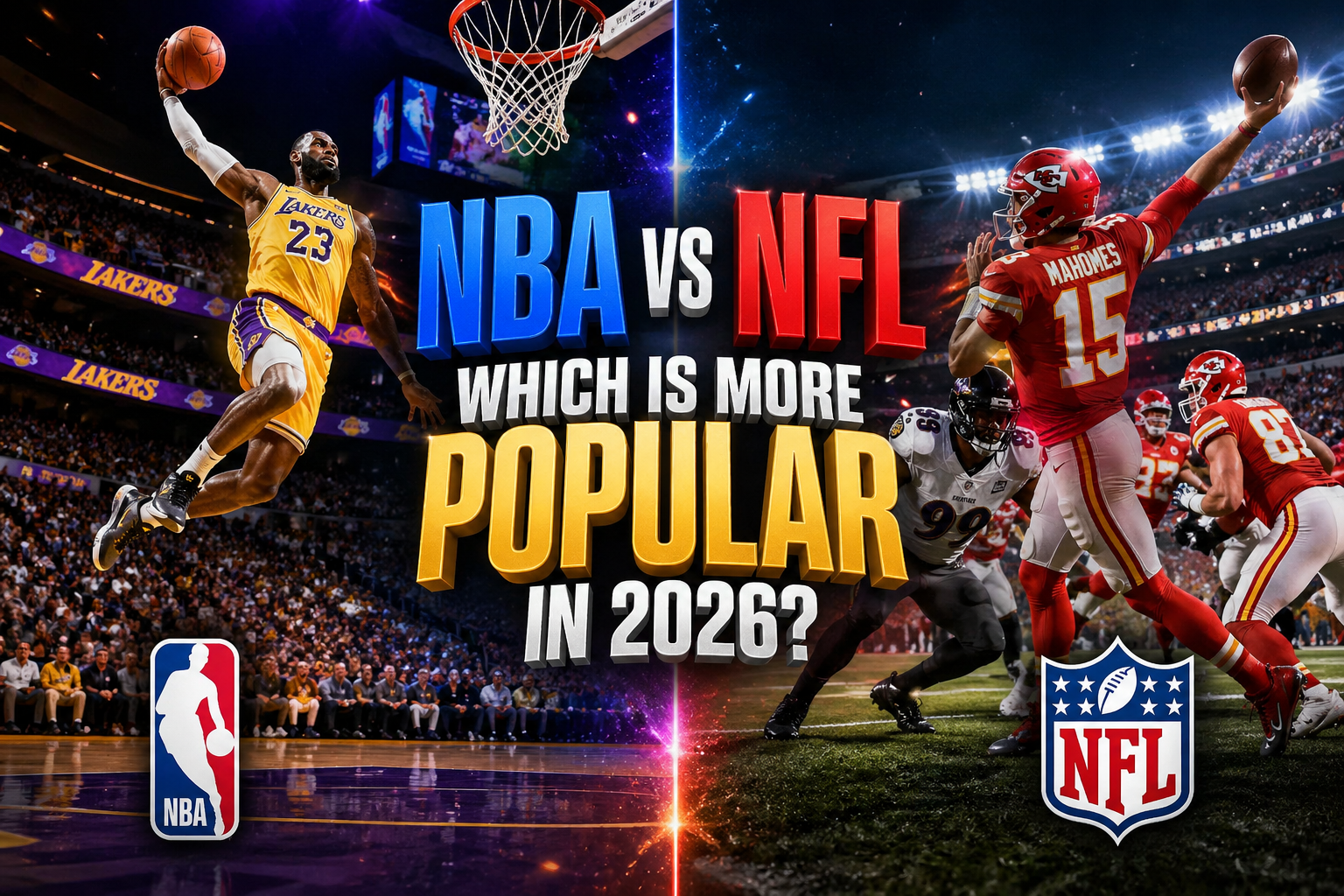
NBA vs NFL Which Is More Popular in 2026? (The Data Will Surprise You)
Every sports bar in America has had this argument at some point. Someone brings up the Super Bowl numbers, someone else fires back with global NBA merchandise sales, and before long two grown adults are debating which sport is actually king.
Lakers vs Rockets Game 4 Prediction
Here’s the thing — both sides have real ammunition. The NFL dominates domestic television ratings in a way no other sport comes close to matching. But the NBA has built something the NFL hasn’t: a genuine worldwide brand that resonates from Los Angeles to Lagos to Manila.
So which league is actually more popular in 2026? We dug into the viewership data, revenue figures, social media numbers, and global reach to give you a definitive, data-backed answer. Let’s settle this.
Quick Verdict
| Category | Winner |
|---|---|
| US TV Viewership | 🏈 NFL |
| Global Reach | 🏀 NBA |
| Total Revenue | 🏈 NFL |
| Social Media Following | 🏀 NBA |
| Average Player Salary | 🏀 NBA |
| Championship Viewership | 🏈 NFL |
| International Popularity | 🏀 NBA |
| Domestic Fan Base | 🏈 NFL |
Overall Winner in the US: NFL Overall Winner Globally: NBA
Round 1: TV Viewership — NFL Wins Decisively
When it comes to raw American eyeballs on a television screen, the NFL is in a completely different conversation from every other sport — including the NBA.
Recent survey data shows that roughly 43% of all US internet adults regularly watch NFL games, making football comfortably the most-watched professional sport in the country. The NBA, by comparison, attracts around 24% of US internet adults as regular viewers. That’s a significant gap — the NFL commands nearly double the domestic viewership of basketball.
The championship numbers make the contrast even starker. The Super Bowl routinely draws over 110 million viewers, making it the single biggest annual television event in the United States. The AFC Championship Game alone recently pulled in over 57 million viewers for one playoff matchup. The NBA Finals, even in a good year, averages somewhere around 11 to 12 million viewers — impressive, but nowhere near football territory.
Even in the golden era of Michael Jordan, when the NBA was at its absolute peak popularity, the league’s biggest-ever single-game audience was under 36 million viewers. The NFL regularly doubles or triples that number for a single playoff game.
Verdict: NFL wins Round 1 by a wide margin.
Round 2: Revenue — NFL Still Ahead, But the Gap Is Closing
Money talks, and in professional sports, it tells you exactly where the fans are.
The NFL generates significantly more total revenue than the NBA, with team valuations reflecting that gap — NFL franchises are worth considerably more on average than NBA franchises. The Super Bowl alone generates more advertising revenue than the entire NBA Playoffs combined in most years.
100+ Special happy birthday wishes for friend
However, the NBA has been closing that gap aggressively over the past decade. The league’s global merchandise sales, international broadcast deals, and partnerships with brands across Asia, Europe, and Africa have fueled consistent revenue growth that the NFL hasn’t matched on the international front.
The NBA’s new media rights deal and expansion into new markets suggest the revenue gap will continue to narrow through the late 2020s. But as of 2026, the NFL holds a clear financial advantage in total league revenue.
Verdict: NFL wins Round 2, but the NBA is gaining ground.
Round 3: Global Reach — NBA Wins Clearly
Here is where the NBA firmly takes the lead, and it isn’t particularly close.
Basketball is a genuinely global sport. NBA players come from over 40 countries, and the league has invested heavily in markets across Europe, Asia, and Africa for decades. Names like LeBron James, Giannis Antetokounmpo, and Luka Doncic carry massive brand recognition not just in their home countries but across entire continents. Mbappé vs Haaland Stats Comparison 2026
The NBA regularly plays preseason games internationally, has a growing presence in Africa through the Basketball Africa League, and benefits from basketball being an Olympic sport with worldwide participation. In countries like the Philippines, France, Serbia, and Nigeria, NBA basketball is a mainstream obsession — not a niche interest.
The NFL, by contrast, remains primarily a North American product. While the league has made genuine efforts to grow internationally — particularly in the UK, where viewership increased dramatically in recent years — American football simply hasn’t embedded itself into global sports culture the way basketball has.
Playing NFL games in London has helped raise awareness, but converting casual observers into genuine fans requires knowing the rules, understanding the strategies, and following rosters — a much steeper learning curve than basketball offers.
Verdict: NBA wins Round 3 decisively.
Round 4: Social Media and Digital Engagement — NBA Wins
The NFL may own American television, but the NBA dominates the digital conversation.
NBA players are among the most followed athletes in the world on Instagram, Twitter/X, and TikTok. LeBron James, Stephen Curry, and Kevin Durant have social media followings that rival the biggest entertainment celebrities on the planet — not just sports figures. This creates a cultural presence that extends far beyond game nights.
The NBA’s highlight culture also translates exceptionally well to short-form video. A spectacular dunk or no-look pass clips perfectly into a 15-second TikTok or Instagram reel. Football highlights are exciting, but the pace of the game and the complexity of plays don’t condense into shareable moments as naturally as basketball does.
The result is that the NBA generates a disproportionate share of sports content on social media relative to its domestic viewership numbers. Young audiences who never watch a full game still consume NBA content daily through social media — a form of brand building the NFL hasn’t replicated at the same scale.
Verdict: NBA wins Round 4.
Round 5: Player Salaries — NBA Wins
If you want to know which league values its players more, look at the paychecks.
NBA players earn significantly higher average salaries than NFL players. The NBA’s salary cap structure, combined with smaller rosters of 12 to 15 players compared to the NFL’s 53-man rosters, means each individual player captures a larger share of league revenue.
Top NBA stars routinely sign contracts worth $50 to $60 million per year. The NFL’s guaranteed money structures and roster sizes spread the salary pool much more broadly, meaning the average NFL player earns considerably less than the average NBA player despite playing in the higher-revenue league.
This matters for popularity because higher-paid stars attract more media attention, bigger sponsorship deals, and greater cultural visibility — all of which feed back into the NBA’s brand strength.
Verdict: NBA wins Round 5.
Round 6: Fan Engagement and Atmosphere — It’s a Draw
Both leagues produce some of the loudest, most passionate fan environments in professional sports — just in very different ways.
NFL game day is an American cultural institution. Tailgating, the weekly ritual of Sunday football, fantasy leagues that turn casual fans into obsessive statisticians — the NFL has woven itself into the fabric of American weekends in a way no other sport has managed. The scarcity of the product matters here too: 17 regular-season games means every single matchup carries enormous weight, which keeps fans engaged at an intensity level that an 82-game NBA season simply can’t maintain throughout.
The NBA offers its own version of fan engagement — shorter seasons give way to frenzied playoff runs, and the star power of individual players creates storylines and personal connections that transcend the team. NBA fans often follow players across franchises in a way that NFL fans, more bound to their regional team identities, typically don’t.
Verdict: Draw — different strengths for different audiences.
The Demographics Tell an Interesting Story
The age breakdown of each league’s fan base reveals something important about where both sports are heading.
The NBA skews younger and more diverse than the NFL. This is both a strength and a challenge — younger fans are the future of any sport, but they’re also less likely to pay for traditional cable packages and more likely to consume content through free social media channels.
The NFL’s fan base trends older and has historically been more tied to traditional television consumption habits — which explains why the Super Bowl still shatters TV viewership records while NBA Finals numbers have been more modest. As cord-cutting accelerates and streaming becomes the primary viewing method, these demographic differences could reshape the competitive landscape considerably.
Why the NFL Wins in America — And Probably Always Will
The NFL’s dominance in the United States comes down to a few structural advantages that are very difficult to overcome.
First, scarcity. Seventeen games in a regular season means every NFL game matters. Fans don’t skip games. Casual fans who might tune out a mid-season NBA game between mid-table teams will still watch a Week 10 NFL matchup between below-.500 teams because the playoff implications are real. This built-in urgency keeps ratings consistently high across the entire season.
Second, the Super Bowl effect. Having one single championship game, rather than a multi-game series, concentrates the entire nation’s attention onto one unmissable event. There is no equivalent in basketball. The NBA Finals, even a seven-game series, cannot manufacture the cultural moment that a single Super Bowl creates.
Third, fantasy football. Roughly 40 million Americans participate in fantasy football leagues, many of whom watch games specifically to track their fantasy players’ performances. Fantasy sports has been a massive driver of NFL viewership for two decades, and football’s statistics lend themselves to fantasy formats more cleanly than basketball’s.
Why the NBA Wins Globally — And Is Growing
Outside the United States, the calculus flips entirely.
Basketball is played everywhere. The rules are simple enough to understand quickly. The court is small enough that even modest facilities can host a game. These structural advantages have allowed basketball to spread into communities around the world in a way that American football — with its complex rules, large teams, and specialized equipment — simply hasn’t been able to follow.
The NBA’s investment in international scouting and player development has created a cycle that feeds itself: global players join the league, their home countries follow the NBA, the NBA’s global brand grows stronger, more international players pursue the league, and the cycle continues.
Giannis winning championships for Milwaukee brings Greece. Luka’s emergence brings Slovenia and much of Eastern Europe. The Basketball Africa League is bringing the continent along. This geographic diversification is the NBA’s biggest long-term advantage over the NFL.
Final Verdict: It Depends on Where You’re Standing
The honest answer is that the winner of the NBA vs NFL popularity debate depends entirely on how you define “popular” and where you’re asking the question.
In the United States: The NFL is the undisputed king of professional sports. Its viewership numbers, revenue figures, and cultural penetration are unmatched by any other sports league in the country. Nothing comes close to the Super Bowl. Nothing has the weekly ritual power of Sunday NFL football. The NFL wins this debate domestically, and it isn’t particularly close.
Globally: The NBA has a stronger case. Basketball’s worldwide participation, the NBA’s international player pipeline, and the global celebrity of NBA stars give basketball a reach that American football simply hasn’t achieved yet.
Among younger audiences: The NBA’s social media dominance, its embrace of player personalities and cultural moments, and its natural compatibility with short-form video content give it a significant edge with fans under 30 — which matters enormously for the long-term health of both leagues.
So which is more popular? In 2026, the NFL wins the headline numbers in America. But the NBA is building something with longer global legs — and that story is still being written.
NFL vs NBA: Key Stats Comparison 2026
| Stat | NFL | NBA |
|---|---|---|
| US Viewership Share | 68% of sports fans | 55% of sports fans |
| Super Bowl / Finals Viewers | 110M+ | 11-12M average |
| Regular Season Avg Viewers | ~17M per game | ~1.5M per game |
| Countries with Active Fans | ~50+ | ~200+ |
| Average Player Salary | ~$3.3M | ~$10.5M |
| Social Media Dominance | Moderate | Very High |
| International Players | ~4% of rosters | ~25% of rosters |
| Games Per Season | 17 | 82 |
| Playoff Format | Single elimination | Best of 7 series |
FAQ
Is the NFL more popular than the NBA in the US?
Yes, by a significant margin. Around 68% of US sports fans watch the NFL compared to 55% for the NBA. The NFL also dominates in TV ratings, with the Super Bowl drawing over 110 million viewers annually.
Is the NBA more popular globally than the NFL?
Yes. Basketball is played in over 200 countries and the NBA has a strong international following, particularly in Europe, Asia, and Africa. The NFL’s global audience is growing but remains primarily North American.
Which sport makes more money, NFL or NBA?
The NFL generates more total revenue than the NBA as of 2026. However, NBA players earn higher average salaries because basketball rosters are much smaller.
Which league has better social media presence?
The NBA dominates social media, particularly among younger audiences. NBA players are some of the most followed athletes in the world across all platforms.
Which sport is growing faster?
The NBA is growing faster internationally, while the NFL remains dominant and stable domestically. Both leagues have secured major new media rights deals that will fuel growth through the end of the decade.
Conclusion
The NFL and NBA aren’t really competing in the same race. One is the undisputed champion of American sports culture. The other is building a global empire, one continent at a time.
In 2026, if you had to pick one, the NFL wins the popularity crown inside the United States — it’s not close. But if you’re thinking about which league is better positioned for global growth over the next two decades, the NBA’s argument gets a lot more interesting.
The better question isn’t which is more popular today. It’s which will be more popular in 2040 — and that answer is genuinely unknown.
What do you think? Drop your take in the comments below. Are you Team NFL or Team NBA?
#NBA vs NFL Which Is More Popular#NBA vs NFL Which Is More Popular#NBA vs NFL Which Is More Popular#NBA vs NFL Which Is More Popular#NBA vs NFL Which Is More Popular#NBA vs NFL Which Is More Popular#NBA vs NFL Which Is More Popular#NBA vs NFL Which Is More Popular#NBA vs NFL Which Is More Popular#NBA vs NFL Which Is More Popular#NBA vs NFL Which Is More Popular



4 comments